
Why Is My Electrical Outlet Warm? When It's a Fire Risk
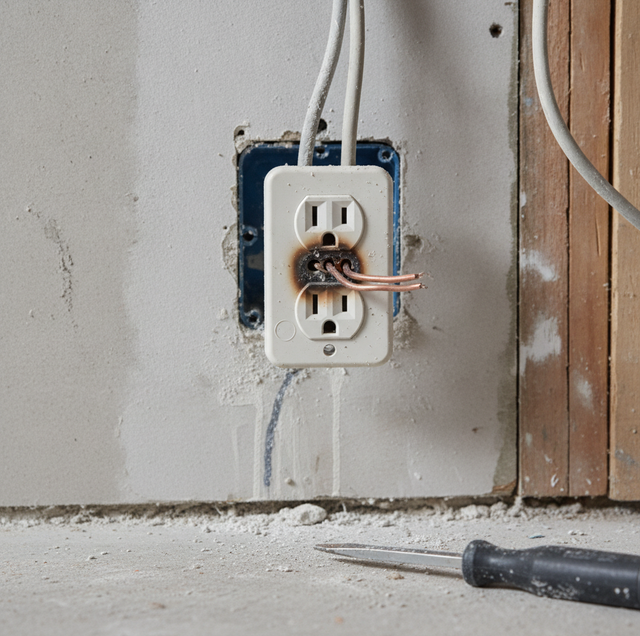
An electrical outlet has no business being warm. It is a set of metal contacts that hands current off to whatever you plug in, and when everything is connected tightly, almost no energy is lost at the outlet itself. So, when the wall plate feels warm under your fingers, or the receptacle is truly hot, that warmth is telling you something: somewhere inside that box, electricity is meeting resistance it should not encounter, and that resistance turns current into heat.
That is the whole story in one sentence, and it is worth understanding before you decide whether to shrug or shut off the breaker. Heat at an outlet is almost always a connection problem. Current wants a clean, low-resistance path. Give it a loose screw, a corroded splice, or a worn contact, and it has to force its way across that gap, losing energy as heat right at the weak point. Electricians put it plainly: a good connection stays cool, a bad one cooks.
The Loose Connection Behind Most Warm Outlets
Walk it back to where the wires actually meet the outlet. A standard receptacle gives you two ways to attach the wires. The first is the side screws, the brass terminals on the flanks of the device, where the wire wraps around a screw and gets clamped down. The second is the backstab holes on the rear, where you push a stripped wire straight in, and a small internal spring clip is meant to hold it.
Backstabs are faster to wire, which is why builders and rushed installers reach for them, and they are also a leading cause of warm outlets. That little clip bears on a tiny patch of the wire, and over the years of heating and cooling, each time the circuit draws power, the metal relaxes, and the grip loosens. Now the joint is carrying the same current across a worse and worse contact. Resistance climbs, heat builds, and the plastic around the contact starts to darken. A side-screw connection, tightened down on a clean clockwise hook of copper, has far more surface pressing together and holds up much longer. When an electrician finds a warm outlet wired with backstabs, the usual fix is to release those wires and move them to the screws, or to pigtail them, which is often the entire repair.
When the Circuit Is Simply Carrying Too Much
Sometimes the connection is fine, and the load is the problem. Every branch circuit has a ceiling. A 15-amp circuit on 14-gauge wire is rated for 15 amps but built to carry about 12 amps continuously; a 20-amp circuit on heavier 12-gauge wire is rated for 20 amps and can carry about 16 amps continuously. A single space heater pulls around 12.5 amps on its own. Add a second heater, a hair dryer, or a window unit on the same circuit, and you are running the wire and every outlet on it close to its limit for hours at a stretch.
Push that much current through the system and everything along the path warms up, including the outlet you happen to touch. This is where daisy-chaining bites. In most homes the outlets on a circuit are wired in a chain, one feeding the next, so a receptacle near the front of the run carries the current for everything plugged in downstream of it. Load up the whole circuit with high-draw devices, and that first outlet becomes a bottleneck, heating even if nothing is plugged into it directly. The honest fix is rarely a new outlet. It is spreading the load out, or adding a dedicated circuit for the heavy appliance, so it stops sharing.
The Outlet That's Warm With Nothing Plugged In
That daisy-chain wiring also explains one of the more unsettling versions of this problem: an outlet that is warm with nothing plugged into it at all. If that receptacle sits mid-run and feeds others, it is still passing current through its own contacts to reach the outlets beyond it. A loose backstab or a tired terminal on a pass-through outlet will heat up from that borrowed current alone, no local load required. It feels like the outlet is haunted. It is really just doing quiet work you cannot see, across a joint that has gone bad.
A Receptacle That Has Simply Worn Out
Outlets are mechanical parts, and they wear. Inside every receptacle are spring-metal contacts that pinch the blades of your plug and hold them. Plug and unplug a few thousand times, run a heavy load through cheap builder-grade contacts, and that spring tension fades. A plug that goes in loose, or falls halfway out under the weight of its own cord, is the classic tell. A loose grip means the blades no longer seat firmly, which increases contact resistance and can even let the connection arc as it makes and breaks. Both put heat right at the face of the outlet. Once a receptacle is worn to this point, no amount of tightening the wires behind it helps; the device itself is done and needs replacing, ideally with a spec-grade or commercial-grade unit if it feeds something demanding.
Aluminum Wiring and the Slow Creep of Oxidation
Some older homes, including a fair amount of the housing stock built in the mid-1960s through the 1970s, were wired with solid aluminum branch wiring instead of copper. Aluminum is a good conductor, but it performs poorly at connections. It expands and contracts more than copper as it heats and cools, so terminations slowly work themselves loose. Worse, exposed aluminum grows a thin oxide skin, and aluminum oxide is a poor conductor. That oxidized film adds resistance right at the screw, and resistance means heat, which speeds up the oxidation, which adds more heat.
This is why a warm outlet on an aluminum-wired circuit is not a thing to sit on. The correct repair uses devices and connectors rated for aluminum, marked CO/ALR, or copper pigtails joined to the aluminum with a listed connector and antioxidant compound where the method calls for it. Standard copper-only outlets are a known bad match for aluminum and a real fire risk.
A Bad Connection Somewhere Upstream
If the outlet itself checks out, the trouble may be further back on the line: a loose lug at the breaker, a poorly made splice in a junction box, or a failing connection on the outlet that feeds this one. A high-resistance joint several feet away can raise the temperature of the wire and the box you are touching, which is why chasing a warm outlet means checking the whole circuit, not just swapping the one device. In a damp climate, moisture works its way into the garage, crawlspace, and outdoor boxes and corrodes those connections faster; the wiring inside your dry living-room wall fails on a slower clock, but the mechanism is the same: a loose or corroded joint either way.
Warm Can Be Normal, Hot Is a Warning
Not every bit of warmth means trouble, and it helps to know the difference. A phone charger, a laptop power brick, or the plug-in power supply for a doorbell or low-voltage outdoor lighting will run warm on its own; converting voltage always produces a little heat, and that heat stays in the adapter body, not in the outlet. A dimmer switch, especially one running a large bank of lights, is designed to shed heat through its faceplate and can feel warm to the touch and still be perfectly fine. In these cases, the warmth is in the device, and if you unplug the charger, the outlet cools right down.
The line to watch is the outlet itself. A receptacle or wall plate that is warm with nothing plugged in, warm under a light load, hot enough that you do not want to keep your hand on it, or showing brown scorching, melted plastic, or a fishy burning smell has crossed into hazard. Warm-but-you-can-hold-it on a charger is one thing; too hot to touch, or discolored, is a stop sign.
A hot outlet, a burning or fishy smell, buzzing, or scorch marks around the slots can mean an active loose connection is arcing inside the wall, and arcing connections start fires. Stop using the outlet, unplug anything on it, switch off the breaker that controls it, and have it checked before you turn it back on. Do not simply cover it and forget it.
What a Warm Outlet Is Really Telling You
A warm outlet is a symptom with a short list of causes: a loose backstab or terminal, a circuit carrying too much, a pass-through outlet feeding others, a receptacle worn past its grip, oxidizing aluminum connections, or a bad joint upstream. What they share is resistance where there should be none, and heat is how resistance announces itself. That is why the safe move when an outlet is truly hot is not to live with it. Killing the breaker removes the danger; finding which connection went bad restores the outlet for good.
A trained electrician does not guess at this. With the cover off and a known load on the circuit, a good tech reads each connection with an infrared thermometer or thermal imaging camera, which lights up the hot joint clearly, then checks the terminations, the device, and the wiring method. The repair is usually small once the weak point is found, and finding it early is what keeps a warm outlet from becoming a scorched one.
Frequently Asked Questions
These add-ons carry their own electronics, so a little warmth in the device body can be normal. A smart plug or a plug-in timer has a relay and a small power supply inside, and switching a heavy load like a heater through that relay heats its internal contacts; a plug-in GFCI adapter runs its sensing circuit whenever it is powered and can feel slightly warm too. What matters is where the heat lives. Grip the add-on body, then touch the outlet face itself: the warmth in the device that fades once you unplug it is the electronics doing their work, while the outlet face that stays warm points back at the receptacle or its wiring. A smart plug that gets truly hot switching a big load is undersized for it and should be swapped for one rated higher, or the appliance wired to its own connection.
Yes. On copper, a warm outlet is something to fix soon; on solid aluminum branch wiring, it moves faster and deserves a quicker call. Aluminum expands and contracts more than copper each time the circuit heats, so its terminations loosen on their own, and any bare aluminum grows an oxide skin that conducts poorly. That oxide adds resistance, resistance adds heat, and the heat speeds the oxidation, so a joint that is only warm today can run away toward charring. The trap is assuming a warm aluminum connection just needs its screw snugged down: re-tightening buys a little time, but the oxide reforms and the joint loosens again. The lasting repair is a copper pigtail joined to the aluminum with a listed connector such as an AlumiConn block or a COPALUM crimp, so the outlet lands on copper and the aluminum joint is made once, correctly.
Sometimes, and only if the receptacle itself is the worn part. If the contacts have lost their grip, a new device solves it. But if the real fault is a loose backstab, an oxidized aluminum joint, or an overloaded circuit, a fresh outlet wired the same careless way will warm up again. A proper repair moves the wires to the screw terminals or pigtails them, torques them down, confirms the wire gauge matches the breaker, and checks the load, rather than just snapping in a new part.
No. Full rewiring is one option, but the more common remediation keeps the aluminum and treats the connections. That means CO/ALR-rated devices made to handle aluminum or copper pigtails bonded to the aluminum with a listed connector such as an AlumiConn or a COPALUM crimp. The point is to stop the oxidation and loosening at every termination. What you should not do is put ordinary copper-only outlets on aluminum wire, which is the pairing that causes the overheating in the first place.
If it is faintly warm only while a charger or dimmer is working and cools when you unplug, you can keep an eye on it. If it is warm with nothing plugged in, warm under a modest load, hot to the touch, or discolored, stop using it and switch off its breaker. Continuing to load a warm outlet lets a loose connection get hotter, and a connection hot enough to char its own housing is one that can arc and ignite the surrounding material. Label the breaker off so no one flips it back on before it is repaired.
The fast, non-destructive method is thermal imaging. With the circuit under a known load, an infrared camera or a spot thermometer shows the exact joint running hot, whether it is a backstab, a terminal screw, a splice, or a breaker lug. From there, the electrician opens that point, inspects the wire and the device for scorching or a loose spring clip, remakes the connection correctly, and rechecks the temperature. Because the heat pinpoints the fault, the actual fix is usually quick once the diagnosis is done.
If an outlet in your home is hot to the touch, discolored, or warm even when nothing is plugged in, have it diagnosed before it becomes a fire risk. Safeline Electric serves Vancouver, Camas, Battle Ground, and the surrounding Clark County and Southwest Washington area. Call (360) 505-0663.
