
Can Your Panel Handle an EV Charger? How to Tell
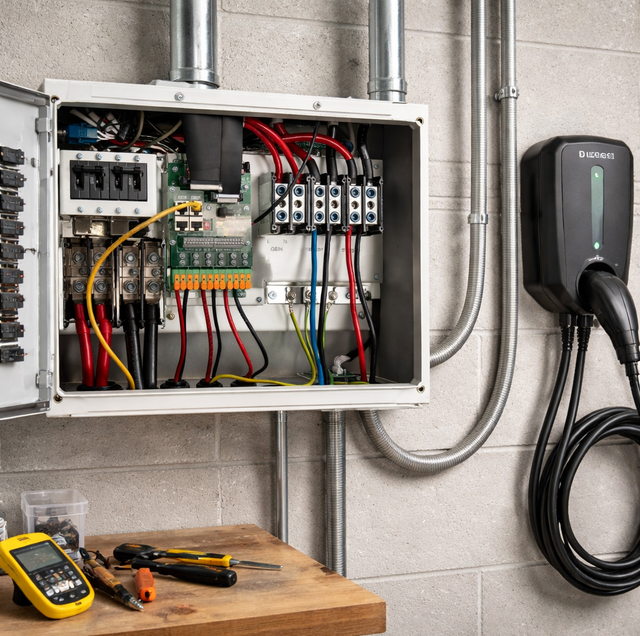
The new EV is in the driveway. The cord that came in the trunk trickles a few miles of range an hour from a regular outlet, which is fine until the first morning you leave with less charge than you wanted. So you start pricing a real Level 2 charger for the wall, and one question sits in front of every other one: can the panel you already have actually feed it, or does adding a charger mean opening up the whole electrical service first?
The good news is that this is a knowable answer, not a guess. An electrician settles it the same way every time, by comparing what your service is built to deliver against what the house already draws and then seeing whether a charger fits in the gap. Plenty of homes have the room and never realize it. Others are closer to the edge than they look. What follows is the logic that decides which one you have, plus the ways to fit a charger even when the margin is tight.
The Number That Really Decides It Is Your Service Amperage
Your home has one hard ceiling on how much power it can pull at once, and it is set at the main breaker at the top of the panel. That breaker matches your service amperage, the current the utility feed and service conductors are built to carry. Common ratings are 100, 125, 150, and 200 amps. Whatever that number is, every circuit in the house shares it. Add up everything running in a given minute, and the total has to stay under that ceiling, or the main breaker does its job and opens.
A Level 2 charger matters here because it is one of the largest loads a house can add, and it behaves differently from most. A residential Level 2 unit typically wants a 40- to 48-amp circuit, and it holds that draw steadily for hours while the car fills. Electricians treat anything that runs for three hours or more as a continuous load, and continuous loads are counted at 125 percent of their rating in the sizing math. So a charger set to pull 40 amps is weighed as 50 amps of demand, and a 48-amp charger as 60. That surcharge is the reason a charger can tip a service that handled a dryer and a range without complaint.
What a Load Calculation Actually Weighs
Before anyone recommends a service upgrade or clears you to add a charger, the honest step is a load calculation. It is not a matter of adding up every nameplate in the house, because your dryer, oven, water heater, and heat pump almost never run flat out in the same instant. The calculation applies demand factors, weighting each load by how much it realistically coincides with the others. The pieces it weighs are the ones that move the total:
- General lighting and receptacles: a baseline figured from the home's square footage, covering the everyday outlets and lights.
- The kitchen and laundry: the electric range, cooktop, or wall oven, plus the clothes dryer, each a sizable dedicated circuit.
- Water heating: an electric tank water heater is a steady multi-thousand-watt draw when it recovers.
- Heating and cooling: the calculation takes the larger of the heat or the air conditioning load, since they do not run at the same time, and a heat pump counts year-round because it works in both directions.
- The EV charger, marked up: added last at that 125 percent continuous rate.
Run those numbers, and you get a realistic peak demand for the house. Subtract it from your service rating and the remainder is your headroom. If the charger's marked-up load fits inside that headroom, your service can carry it. If it does not, the charger is asking for capacity the service does not have, and no breaker trick changes that.
Running Out of Slots Is Not the Same as Running Out of Power
Here is where two very different problems get mistaken for each other, and the fix depends entirely on which one you have.
The first problem is space. A charger needs its own two-pole breaker, and your panel may not have two open positions left. That is a slots problem, and it is often the smaller of the two. A packed panel can still sit well under its capacity, because most of those breakers feed circuits that draw a trickle most of the time. Freeing up room can be as simple as swapping two full-size breakers for a tandem breaker (a slim breaker that fits two circuits in one slot, where the panel is rated to accept them), or adding a subpanel fed from the main to house the new circuit. Neither one raises the ceiling; they just make a place to land the wire.
The second problem is capacity. This is when the load calculation shows the house is already near its service rating, so even with a slot open, the charger's demand would push the total past what the main can supply. No tandem breaker or subpanel helps here, because the constraint is the amperage coming in, not the physical box. Telling the two apart is the whole game: a full panel with spare capacity is an easy day, while an empty-looking panel on a maxed 100-amp service is the one that needs real work.
Three Ways to Fit a Charger Without Upsizing the Service
When the calculation shows the margin is thin, an upgrade isn't the only option. Several approaches let a charger coexist with an existing service, and a good electrician will price these against a full upgrade rather than defaulting to the bigger job.
- Dial the charger's amperage down: Most hardwired Level 2 units have an adjustable output, set during installation to 16, 24, 32, 40, or 48 amps. Sizing the charger to whatever headroom the calculation found lets it fit a service that a full-speed unit would overrun. A charger set to 24 amps instead of 48 still adds meaningful range overnight, and for a car that sits home eight hours, it is often more than enough.
- Add a load-management device: An electric vehicle energy management system, or EVEMS, is a small controller that lets the charger share capacity instead of demanding its own reserved block. One style uses a current sensor clamped on the main feed and throttles or pauses the car whenever whole-house demand climbs, then hands the power back when the oven or dryer shuts off. Another shares a single existing circuit, commonly the dryer, so the car and the appliance take turns rather than running together. Because the system guarantees the charger backs off before the service is overloaded, it can make a charger workable on a panel that a straight calculation would reject.
- Shift the charging to off-peak hours: Nearly every EV and charger can be scheduled to run in the small hours, when the range, the oven, and much of the heating or cooling load are idle. This does not add capacity, but it keeps the charger from stacking on top of the day's peaks, which lowers the real-world chance of tripping the main and is the simplest lever of the three to pull.
These are not all-or-nothing. A dialed-down charger on a timer, backed by an EVEMS, can stretch a modest service a long way.
When a Service Upgrade Is the Honest Answer
Sometimes the workarounds only paper over a service that has truly run out of room, and the straight fix is to raise the ceiling. That points less at the charger alone and more at everything stacking behind it: a heat pump going in the same year, an older 60- or 100-amp service already near its calculated limit, a shop or accessory-unit feeder, or a plan to add a second EV down the road. When two or three large loads land together, an upgrade to a larger service (often 200 amps) can be the cleaner long-term move than nursing a tight panel with controls. Deciding that is its own question with its own calculation, and it is worth weighing on the merits rather than assuming every charger triggers it. For the majority of single-charger installs, it does not.
How to Find Out Where You Stand
You can get most of the way to an answer yourself. Read the main breaker for your service amperage, count your open slots, and take stock of the big electric loads already in the house and the ones you are planning. That tells you roughly how much room you are working with. The exact call, though, comes from a load calculation run against your actual circuits, because the demand factors and the continuous-load markup are where a rough guess and a real number part ways. Once that number is in hand, the charger decision stops being a worry and becomes a short list of options: fit it as-is, dial it in, manage it, or raise the service.
Frequently Asked Questions
Sometimes, but check two things first. A plug-in charger on a NEMA 14-50 receptacle is limited to a 40-amp continuous output, because a plug-in circuit is capped at 80 percent of the 50-amp breaker feeding it, whereas a hardwired unit can run 48. Also confirm the outlet is on its own dedicated circuit sized for continuous use; some 14-50 outlets were installed for an occasional welder or RV and are not built to hold 40 amps for hours. Modern EV receptacle circuits also require GFCI protection, which occasionally nuisance-trips with certain chargers, one more reason many installers hardwire instead.
Less than most people expect, because the limiting factor is usually hours parked, not charging speed. As a rough guide, a 48-amp charger adds in the neighborhood of 35 miles of range per hour, 32 amps around 25, and 24 amps close to 18. Most drivers replace 30 to 40 miles a day, so even a 24-amp setting refills a normal commute in a couple of overnight hours. A lower setting mainly matters if you routinely drive long distances and need a near-empty battery full by morning.
Rarely, because it only intervenes when the house is actually drawing heavily, which is a small slice of the night. The controller watches total demand and trims the car only while the range, dryer, or heat pump are running hard, then restores full output the moment they stop. Since most charging happens after midnight when the rest of the house is quiet, the car usually sees full speed for the bulk of the session. The trade is a device and a sensor install in exchange for skipping a service upgrade.
A 48-amp hardwired charger is a continuous load, so it lands on a 60-amp two-pole breaker (48 times 1.25 equals 60). The conductors are sized to match that breaker and the run length; a common choice is 6 AWG copper, though a long run or a hot attic can push an electrician to upsize the wire to offset voltage drop and heat derating. A 40-amp charger drops to a 50-amp breaker. The exact wire is a field call, which is why the circuit is sized at the install, not from a chart.
It roughly doubles the continuous load you are asking the service to hold, which is often what tips a comfortable single-charger house into upgrade territory. The cheaper path is usually one EVEMS controller managing two chargers so the pair share a capacity budget and take turns at peak, rather than reserving a full block for each. If a second car is even a maybe, it is worth sizing any new subpanel or conduit for it now, since pulling a second run later costs far more than leaving room the first time.
Not automatically. It depends on your service size and whether the two would ever peak together. A heat pump and a charger on a healthy 200-amp service frequently coexist without issue. The pressure shows up on smaller services, where both are large continuous loads competing for the same headroom. This is a textbook case for a load-management device, which can shed or slow the car whenever the heat pump is working hardest, so the two never demand full power from the service at the same moment.
Ask a licensed electrician to run a load calculation before you buy a charger — you'll know exactly what your panel can carry and which option fits. Safeline Electric serves Vancouver, Camas, Battle Ground, and the surrounding Clark County and Southwest Washington area. Call (360) 505-0663.
