
What Is Knob-and-Tube Wiring, and Is It Safe Today?
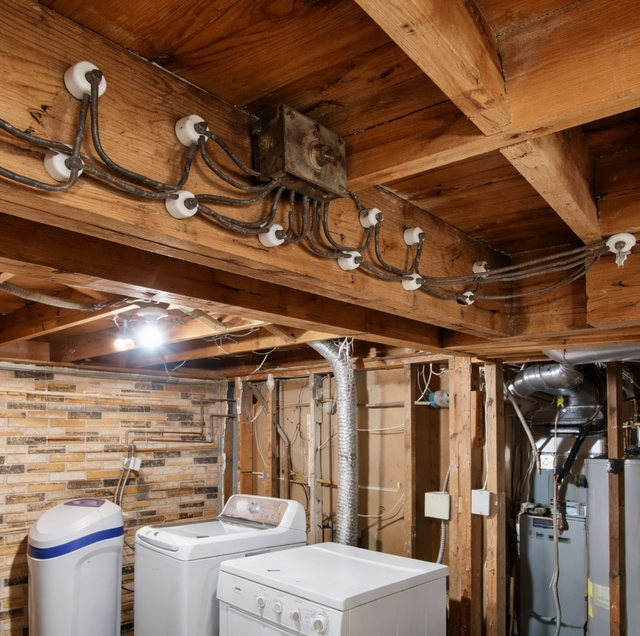
Knob-and-tube wiring is the original standardized way houses were wired for electric light: two separate cloth-covered copper conductors, a hot and a neutral, suspended in open air on porcelain knobs and slipped through ceramic tubes wherever they pass through the framing. It was the accepted method from the 1880s into the 1940s, and a fair amount of it is still sitting in older homes, some of it still carrying load. People usually meet it while poking around an attic or basement and spotting a lone cloth-jacketed wire on white spools, which raises the same two questions every time. What is this, and is it something to worry about?
The honest answer is that knob-and-tube is not a defect at first sight, and it is not automatically a fire waiting to happen. It was an accepted wiring method for decades, and plenty of it still carries load quietly today. What it is, though, is old, ungrounded, and easy to compromise, and those three facts decide whether the run in your house is fine as-is or overdue for attention. This piece explains how the system works and where the real risk comes from, so you can tell the difference.
What Knob-and-Tube Wiring Actually Is
Knob-and-tube, often shortened to K&T, was the standard method for wiring homes from roughly the 1880s into the 1940s, and it shows up in houses built or updated in that window. The name describes the two ceramic parts that define it.
The knobs are porcelain spools nailed to the framing. The wire wraps around them and is tied off, which holds each conductor suspended in open air at a set distance from the wood and from the other conductor. The tubes are ceramic sleeves that line any hole where a wire has to pass through a joist, stud, or plate, so the conductor never touches the wood as it crosses. Where a wire enters a box or gets close to something, a flexible woven sleeve called a loom protects it.
The defining trait is that the hot and the neutral run as two separate single wires, not bundled together in one jacket the way modern cable is. They travel parallel, spaced apart, relying on air and the ceramic to insulate them. That open-air spacing is the whole design idea: the wire was rubber-and-cloth insulated, and running it in free air let heat shed off it. Splices were twisted, soldered, and wrapped in cloth tape rather than made inside a junction box. And critically, the system has only two wires. There is no third conductor, no equipment ground, because grounding of ordinary branch circuits did not become standard practice until well after K&T fell out of use.
How to Recognize It in an Older Home
You will not see knob-and-tube behind a finished wall, but it announces itself where wiring is exposed: in the attic, the basement or crawlspace, along the joists and rafters, and at the top of the electrical panel. The tells are the white ceramic knobs standing off the framing, the tubes at every pass-through, and single cloth-jacketed wires running individually rather than a sheathed cable with several conductors inside. The cloth insulation is usually a dull black or brown, often frayed at the ends. Two-prong outlets throughout the house are a supporting clue, since ungrounded wiring has no third slot to serve, though many homes have had newer outlets swapped in without the wiring behind them changing.
One important distinction: not every length of K&T you find is still energized. Over the decades, homes get partially rewired, and old runs are frequently abandoned in place, left lying in the attic with no power on them. Live knob-and-tube and dead knob-and-tube look identical, which is why identifying which is which is a job for testing rather than a guess.
Why It Worked in Its Day
Knob-and-tube was not a shortcut for its time. The open-air layout gave the conductors excellent heat dissipation, arguably better than a modern cable bundled tight in a wall, and the ceramic parts are essentially inert and do not degrade. Undisturbed K&T with its original insulation intact has carried light residential loads for a century in some houses.
The catch is everything the method assumed: that the wire would stay in open air, that loads would stay modest (a few lights and a small appliance on 60-amp service, not a kitchen full of countertop appliances plus a window air conditioner), and that nobody would ever touch it. A hundred years of houses being remodeled, insulated, and rewired by whoever was cheapest is what turned a sound method into a liability.
Where the Risk Comes From Now
The concern with knob-and-tube today is rarely the original installation. It is what age and decades of hands have done to it, plus the mismatch with how we use electricity now. Four things drive the risk.
No equipment ground: K&T is a two-wire system with no grounding conductor, so there is no safe path to carry a fault to ground. That means no true grounded three-prong outlets, no protection for the metal cases of tools and appliances, and no easy way to ground surge protectors or sensitive electronics. It is the single feature that most separates K&T from any wiring installed in the last several decades.
Brittle, failing insulation: The rubber-and-cloth insulation on the conductors was never meant to last a century. Rubber dries out, cracks, and flakes off, especially where heat has cooked it near light fixtures or where it has been handled. Once the insulation crumbles, you have bare or nearly bare conductors a few inches apart, and that is where shorts and arcing begin.
Amateur modifications and splices: This is the big one. Over the years, homeowners and handymen tap into K&T to add outlets, extend circuits, or join it to modern cable, and they do it badly. Splices made outside a junction box, connections wrapped in electrical tape instead of soldered, modern Romex spliced onto old cloth wire mid-run with no box to contain a fault, circuits piggybacked until the old wire is carrying far more than it was meant to. Each bad splice is a potential hot spot. The method itself may be sound where nobody has touched it, and dangerous three feet away where someone did.
Modern load and overfusing: A circuit sized for a few bulbs gets asked to run a space heater, a microwave, and a hair dryer. When that old wire runs warm, and someone's answer was to swap the fuse or breaker for a bigger one so it stops blowing, the protective device no longer matches the wire. The wire can now overheat without ever tripping the protection, which is exactly the condition that starts fires inside walls.
The Insulation-Contact Problem, Specifically
There is one risk that deserves its own explanation, because it is both the most common and the least obvious: burying knob-and-tube in thermal insulation.
Remember that the entire method depends on the conductors shedding heat into open air. Its safe current-carrying capacity, its ampacity, was calculated on that assumption. Pack blown-in cellulose or fiberglass batts around and over live K&T, and you take away the air. The heat the wire normally sheds now has nowhere to go, so it builds up in the conductor and in the already-brittle insulation around it. Over time, that accelerates the breakdown of the cloth and rubber and raises the temperature of the whole run.
This is why energy retrofits are a frequent trigger for K&T problems. A well-meaning attic insulation upgrade, done without anyone checking what is underneath, buries active knob-and-tube and quietly turns a stable circuit into an overheating one. Many jurisdictions and weatherization programs require that active knob-and-tube be de-energized or removed before insulation is added over it. If your attic has both, that is worth an evaluation before you add another inch.
What Electricians Usually Recommend
For active knob-and-tube, the common recommendation is replacement, and the reasoning is practical rather than alarmist. You cannot ground it, you cannot safely bury it, its insulation is at or past the end of its service life, and you often cannot know how many bad splices are hidden in the walls. A full or partial rewire replaces the old two-wire runs with modern grounded cable, adds junction boxes where connections belong, and lets the circuits be properly protected and sized for how the house is actually used.
Replacement does not always mean the whole house at once. An electrician can prioritize the runs that matter most- the kitchen, bath, and any circuit carrying heavy load- and phase the rest, tying new grounded circuits back to the panel and abandoning the old K&T as each area is done. What is generally not recommended is the cheap path: adding bigger fuses, splicing new onto old outside a box, or insulating over live runs. Those are the moves that turn tolerable old wiring into a hazard.
If you are not rewiring immediately, the interim priorities are simple: keep insulation off any live K&T, do not overload the old circuits, replace ungrounded outlets correctly rather than forcing a three-prong where there is no ground, and have any warm spots, flickering, or scorched smells looked at rather than lived with. An inspection that maps what is still active and what is already dead is the honest first step, because you cannot plan for wiring you have not traced.
Deciding Whether Yours Has to Go
Knob-and-tube is not automatically dangerous, and it is not automatically fine. Undisturbed, unburied, lightly loaded, and with sound insulation, it can be reliably low-risk, which is why blanket panic about it is misplaced. But every one of those conditions works against it as a house ages: insulation gets added, loads grow, and someone eventually splices into it. Add the fact that it can never be grounded, and the long-run direction is clear even when there is no emergency today. The right call comes from knowing what you actually have, live versus abandoned, original versus modified, buried versus open, before deciding whether to rewire now or plan for it later.
Frequently Asked Questions
You cannot tell by looking, since energized and dead runs are identical, so it comes down to testing. A non-contact voltage tester held near the conductor indicates whether it is hot, but that only checks the spot you can reach. Tracing a run properly means working from the panel, identifying which breaker or fuse feeds it, and confirming the whole length. Many older homes have a mix: some K&T abandoned during a past partial rewire, some still carrying lights or outlets. That distinction changes the plan, since dead runs can simply be removed while live ones need decisions.
Not over active runs. Because K&T sheds heat into open air, covering it with insulation traps that heat and degrades the aging insulation faster, and many local weatherization and building rules require live knob-and-tube to be de-energized or removed before insulation goes over it. If the run is confirmed dead, it is not a heat concern. The safe sequence is to identify and deal with any live K&T first, then insulate, rather than the common mistake of burying it during an energy upgrade and creating a hidden hot spot.
No, they are different eras and failure modes, though people lump them together as "old wiring to worry about." Knob-and-tube is pre-1940s two-wire copper with no ground. Aluminum branch wiring showed up mainly in homes wired in the mid-1960s to mid-1970s, and its issue is that aluminum expands, contracts, and oxidizes at the connections, loosening terminals over time. Aluminum is grounded and bundled in modern-style cable, so its fix is often specialized connectors (such as COPALUM or AlumiConn) or pigtailing at devices rather than a full rewire.
Yes, and this is a useful point many homeowners miss. A GFCI works by comparing current on the hot and neutral and does not require a ground to function, so a GFCI can be installed on an ungrounded circuit to provide shock protection. Outlets protected this way must be labeled "GFCI Protected" and "No Equipment Ground," because they still lack a true ground for surge and equipment-case protection. It is a legitimate way to make an ungrounded two-prong location safer for people, but it does not turn K&T into grounded wiring or address its other age-related risks.
No. A rewire can be phased, and electricians often stage it by priority. High-demand and wet-area circuits like the kitchen and bathrooms usually go first, with new grounded cable run back to the panel and the old K&T abandoned as each section is finished. Access drives the difficulty far more than the wire itself, so runs reachable from an attic, basement, or crawlspace are simpler than those buried inside finished plaster walls. Phasing lets you address the highest-risk circuits promptly and spread the rest out.
Some do ask about it. It is common for a home insurer or a mortgage lender to want to know whether a house has active knob-and-tube. That is a policy question for your provider rather than an electrical one, but it is a frequent reason homeowners have the wiring evaluated in the first place. An inspection that documents what is live, what is abandoned, and what has been modified gives you a clear picture to work from, whatever the reason you are asking.
Suspect knob-and-tube behind your walls? Schedule an inspection to map what is active and whether a rewire is warranted. Safeline Electric serves Vancouver, Camas, Battle Ground, and the surrounding Clark County and Southwest Washington area. Call (360) 505-0663.
