
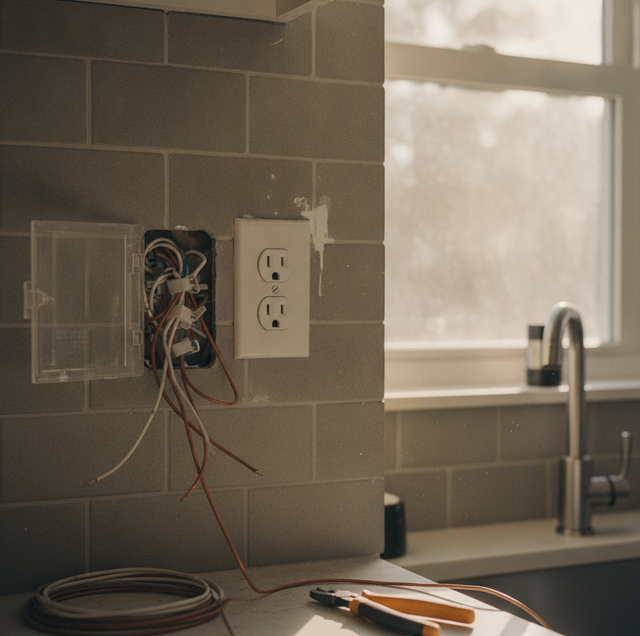
When a GFCI keeps popping, the natural assumption is that the outlet has gone bad. Usually, it has not. A ground-fault outlet has one job: watching for current that leaks out of the circuit instead of returning the way it came, and a repeat trip almost always means it is doing that job on something real. Nothing has to look scorched or smell hot for it to keep cutting power, because it is watching for leaking current, not heat or load.
The useful skill is telling a nuisance trip apart from a warning, and that starts with understanding what the device measures rather than guessing at the outlet. Sort out how a GFCI decides to cut power, and the causes below fall into place.
What a GFCI Is Actually Watching For
A GFCI (ground-fault circuit interrupter) compares two things: the current flowing out on the hot wire, and the current coming back on the neutral. In a healthy circuit, those two numbers are identical, since every bit of current that leaves on the hot returns on the neutral. Both wires pass through a small sensing ring inside the device, and as long as they balance, the ring sees nothing and the outlet stays live.
The moment some of that current finds another way back, the two numbers no longer match. Current leaking through a wet connection, a cracked appliance cord, or a person touching a live part returns to ground by a path that skips the neutral. When the imbalance reaches roughly 4 to 6 milliamps, a few thousandths of an amp, the internal circuit fires and snaps the contacts open in a fraction of a second. That threshold is deliberately tiny, set below the level of current that can stop a heart, which is why these outlets guard kitchens, bathrooms, garages, crawlspaces, and anything outdoors.
So a GFCI does not trip because you plugged in too much; that is the panel breaker's job. It trips because current is escaping the circuit. Keep that in mind, and the causes below sort themselves out.
Moisture in the Box or Cover Is the Usual Suspect
Water conducts electricity, and it does not take a puddle. A film of condensation behind a receptacle, a damp spider web bridging two terminals, or moisture wicking into an outdoor box after a wet spell can leak a milliamp or two to ground. Add that to the normal background leakage of whatever is plugged in, and the total crosses the trip threshold.
This is the number one reason exterior, garage, and bathroom GFCIs trip, and a damp climate keeps those circuits on the ragged edge. Long stretches of wet weather push moisture into outdoor boxes and unconditioned garages; drier months ease it, but summer brings its own version through sprinkler overspray, condensation cycling as the box heats and cools, and humidity in a steamy bathroom. The wet-area circuits stay the year-round weak point.
The fix is usually about keeping water out, not replacing anything electrical. An outdoor receptacle needs a weatherproof in-use cover, the bubble style that closes over a plugged-in cord, not the flat lid that only seals when nothing is plugged in. Gaskets behind the faceplate, sealed cable entries, and the weep holes at the bottom of the box all matter. If an outlet trips reliably in the rain and holds fine once dry, moisture is your answer.
A Real Ground Fault Downstream
Sometimes the leak is not water but a wiring fault or an appliance issue. A nicked cable stapled a hair too tight, a screw driven through a wire behind drywall, a fixture in a damp ceiling, or an appliance with breaking-down insulation can all send current to ground. This is the trip you should never override: the GFCI is catching the exact condition that shocks people, and forcing it to stay reset removes the safety net while the fault sits there.
The tell is that the outlet trips even with everything unplugged and every surface bone-dry, or it trips the instant one specific device is plugged in. That points to a fixed fault rather than passing moisture. Tracing it means isolating the run, checking each connection and fixture downstream, and testing the suspect appliance on a known-good circuit. When a GFCI trips and nothing is wet, treat it as a message, not a malfunction.
Is the Line and Load Wiring Correct?
A GFCI receptacle has two pairs of terminals, and mixing them up is a classic cause of trouble. The LINE terminals take incoming power from the panel; the LOAD terminals send protected power on to other outlets down the circuit. Wire the incoming feed to the LOAD side by mistake, and the device will often not reset at all or will behave erratically.
A related fault lives on the neutral. Every outlet fed from the GFCI has to keep its neutral separate from ground and from any other circuit's neutral past that point. If a downstream neutral touches a ground wire, touches the metal box, or gets crossed with another circuit's neutral, called a shared or bootleg neutral, some return current sneaks off through that connection instead of back through the sensing ring. The GFCI reads the missing current as a leak and trips, even with no faulty appliance and nothing wet. This is why a trip that started right after work was done on the wall usually traces to a wiring mistake, not a bad part.
Too Many Outlets Chained to One GFCI
One GFCI can protect an entire string of downstream outlets via those LOAD terminals, which is convenient, but the limit has nothing to do with amperage. Every device on that chain leaks a tiny, harmless amount of current to ground as a normal part of running. Electronics with power supplies, anything with a motor, surge strips with built-in filtering, each might leak only a few tenths of a milliamp. That is fine on its own.
Stack a dozen of them on one GFCI, and those tiny leaks add up. The standing total can creep close to the 4 to 6 milliamp threshold before a fault exists at all, so it takes almost nothing, a little damp or one more appliance switching on, to tip it over. Nothing is broken; the circuit simply carries more accumulated leakage than one protector can handle. Splitting the load across two GFCIs, or feeding the heavy leakers from their own protection, clears it.
A Motor or Heater Nuisance-Tripping
Big motor and heating loads are notorious for borderline trips. A refrigerator, freezer, sump or well pump, shop vacuum, or portable heater draws a hard inrush the instant it starts, and the motor windings and run capacitors leak a small amount to ground, more so as they age and their insulation breaks down. A circuit that sits quietly at rest can trip the moment the compressor kicks on, because that startup surge briefly pushes leakage past the threshold.
This is the gray zone between a real fault and a nuisance. An older freezer that trips every few days may have a failing motor leaking too much, and it deserves attention; a newer appliance tripping a GFCI it shares with several other things may just be the last straw on an overloaded protector. To tell them apart, give the appliance its own dedicated circuit and its own protection. If a single fridge then trips its own GFCI, the appliance is the problem. If it only tripped while sharing, the sharing was.
When the GFCI Itself Is Worn Out
GFCIs are electronic, and the electronics do not last forever. Heat, sunlight, humidity, and the occasional surge age the internals, and a unit ten or more years old can start tripping on its own or refuse to reset even when the circuit is fine. This is real, but it is the last thing to suspect, not the first, because a healthy GFCI tripping usually means it caught something.
There is a built-in way to check. Every GFCI has a TEST button that should trip it and a RESET that restores power with a firm click. Press TEST monthly; if it does not trip, it is not protecting you and needs replacing. Recent units add an internal self-test that will lock out, refuse to reset, or show a warning light if the self-check fails. A useful rule of thumb: unplug everything, dry the box and its surfaces, and try resetting. If it holds with nothing connected, the device is fine, and something on the circuit was the cause. If it still will not hold on an empty, dry circuit, the device or its wiring is the suspect.
Telling a Nuisance Trip From a Warning
Put the clues together, and most tripping GFCIs sort into two piles. Trips that follow wet weather and clear once dry, which only happen when a specific motor starts, or that come off a long chain of outlets, are usually nuisance trips: the device reacting to leakage that has stacked up or to moisture it was built to respect. Annoying, but sane.
The trips to take seriously have no obvious trigger: an outlet that pops with everything unplugged and every surface dry, one that goes the instant a particular appliance touches it, or one that started right after work was done in the wall. Those points to a real ground fault or a wiring error, and the outlet is standing between that fault and a shock. Either way, the honest answer is that it found something. What is worth answering is whether that something is water you can dry out or a fault that needs tracing before you reset it one more time.
Frequently Asked Questions
Replacing it with a standard receptacle will stop the trips and also strip out the shock protection that the outlet was placed there to provide, a bad trade in a kitchen, bath, garage, or anywhere near water. A GFCI that keeps tripping is giving you information, not failing. If you want to test whether the receptacle itself is the worn part, shift the protection to a GFCI breaker at the panel and put a normal outlet at the wall; if the breaker still trips, the fault is in the wiring or an appliance, not the device you swapped out.
Unplug everything fed from the GFCI, then reset it. If it holds, plug items back in one at a time and watch for the one that trips it. If it will not hold even when empty, the fault is in the downstream wiring; disconnect the LOAD wires and see if the device resets on its own, which would indicate the trouble is somewhere past it on the run. The outlet everyone forgets is a buried or exterior one on the same string, a garage soffit receptacle, or a spot behind a workbench, quietly wet or damaged while you check the obvious ones.
Yes, and one setup causes it more than any other: a multi-wire branch circuit, where two hot wires from opposite panel legs share a single neutral. A standard receptacle-style GFCI cannot protect just one of those hots, because the shared neutral carries return current from a hot that the device never sees, so it always reads an imbalance and trips. That situation needs a two-pole GFCI breaker that protects both hots and the neutral. A cleaner way to confirm any neutral fault is to lift the downstream neutral off the device and reset with only the hot connected; if it holds, the leak is on the neutral side, often a cable staple that nicked the insulation or a neutral pigtailed to the wrong bundle.
Moisture is bridging the connections and leaking to ground, so before assuming the device is bad, kill the circuit and dry the box out; a few minutes with a hair dryer on a warm setting often brings a soaked outlet back to life and tells you water, not hardware, was the cause. Two details people miss: an exterior receptacle should be a weather-resistant (WR) rated device, stamped WR on the face, which uses corrosion-tougher contacts than an indoor unit, and a sealed box can still trip from condensation alone. Temperature swings pull humid air in and leave dew on the terminals overnight, so a shaded north-side outlet that never sees rain can still trip at dawn in any season.
They usually point in different directions. A GFCI that will not reset at all, even with nothing plugged in and everything dry, typically indicates no incoming power on the LINE terminals, a miswired feed on the LOAD side, a failed internal self-test that has locked the unit out, or a dead device. One that resets fine and then trips only when something is plugged in or gets wet is doing its job and reacting to actual leakage. The behavior you are seeing tells an electrician where to look first, so note it before the call.
A passing TEST button only proves the device can trip on command, and a built-in self-test likewise watches the unit's own electronics, not the wiring or the outlets downstream, so both can check out while something on the circuit keeps leaking. When the monthly test passes, but trips continue, take your attention off the device and put it on the run: unplug the downstream outlets one at a time, look for dampness on the exterior or in the garage box, and note whether one appliance's startup aligns with each trip. It also helps to know what a protector covers. A GFCI breaker in the panel guards the whole homerun, every outlet on that circuit, while a receptacle-style GFCI protects only its own face plus whatever is wired to its LOAD terminals downstream, leaving anything ahead of it on the LINE side unprotected.
If your GFCI keeps tripping after you have dried it out and unplugged everything, have the circuit traced before you lose the protection it provides — a licensed electrician can find the current leak and confirm the line and load wiring is correct. Safeline Electric serves Vancouver, Camas, Battle Ground, and the surrounding Clark County and Southwest Washington area. Call (360) 505-0663.
