
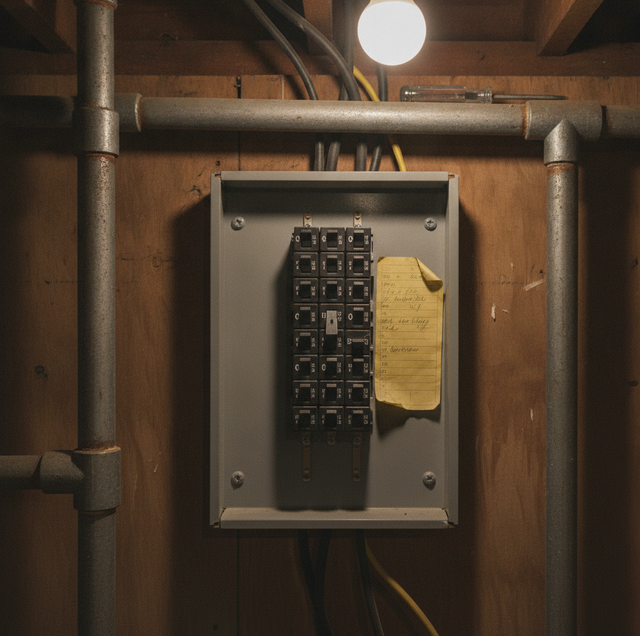
You flip the breaker back to on, hear it seat with a click, and walk away. Ten seconds later, or ten minutes, it snaps to the middle position again, and the room goes dark. You reset it. It trips right back. Somewhere behind that panel, a small mechanical switch is doing exactly what it was built to do, cutting power before something gets hot enough to start a fire. The breaker is not the villain here. It is the messenger, and it is trying to tell you something specific about the circuit it protects.
The trick is learning to read the message. A breaker that trips the instant you reset it is reporting a different problem than one that holds for half an hour and then lets go. A breaker that quits only when the microwave and toaster run together is telling a different story than one that drops every time it rains. Sort those behaviors, and you can tell a minor load-juggling nuisance from a fault that needs a hand inside the panel.
A Quick Read on Why It's Tripping
Notice exactly when and how the breaker lets go, then match it to the closest row.
| What's happening | Likely cause | What to do |
|---|---|---|
| Trips the instant you reset it, even with everything unplugged | A short circuit or a dead short in the wiring | Stop resetting; leave it off and get it diagnosed |
| Holds for several minutes to an hour, then trips under heavy use | Overloaded circuit, too many watts on one line | Move some devices to another circuit |
| Trips only when one specific appliance runs | A fault in that appliance, its cord, or its motor | Unplug it, run it on another circuit to confirm |
| Trips on a bathroom, kitchen, garage, or outdoor outlet, often in damp weather | Ground fault or moisture in a GFCI-protected circuit | Dry the area, reset, and replace the device if it repeats |
| Trips at random with nothing obviously drawing power | AFCI sensing an arc, or a nuisance trip | Note what shares the circuit; have the wiring checked |
| Trips at a light load, or the handle feels loose or warm | A worn-out breaker or a loose connection | Have the breaker and lugs inspected and replaced |
Those rows are a starting point. The sections below explain the mechanism behind each one, because understanding why a breaker trips is what lets you tell a five-minute fix from a real fault.
Overload: Too Much Current, and the Slow Trip
Most household breakers are thermal-magnetic in design, meaning they have two separate ways to trip. The thermal half handles overloads. Inside the breaker sits a bimetallic strip, two bonded metals that expand at different rates when they warm up. Current running through the strip heats it, the strip bends, and when the load stays high long enough, it bends far enough to release the latch and drop the handle.
That heat-and-bend action is deliberately slow, and it explains the timing you feel. An overloaded circuit does not trip the moment you switch on one more device. It trips after the strip has had time to heat, which might be several minutes or most of an hour, depending on how far over the limit you are. A 15-amp circuit is built to carry about 12 amps continuously, and a 20-amp circuit about 16, so a line already near its ceiling will give out when you add a space heater or a hair dryer on top of everything else.
The tell for an overload is that it tracks your usage. It trips when the kitchen is busy or several things run at once, and holds fine once you back off. Nothing is broken. The circuit is carrying more than it was wired for, and the honest fix is to spread that load across more circuits rather than keep resetting a breaker doing its job. In older homes running limited service and a short list of circuits, this shows up constantly, because modern appliance loads outgrew the wiring decades ago.
Short Circuit: Hot Meets Neutral, and the Instant Trip
The magnetic half of the breaker handles the violent stuff. When a hot wire touches a neutral wire directly, current is no longer being metered out through a lamp or a motor. It rushes through the path of least resistance in a surge that can spike to many times the normal draw almost instantly. That surge energizes a small electromagnet inside the breaker, and the magnet yanks the latch open in a fraction of a second. No waiting, no warming strip.
This is why a short circuit trips the moment you reset it, and why it does not care what you have unplugged. The fault is in the wiring or in a device's internal connection, not in the total load. You might have caused it with a nicked wire behind a switch plate, a nail or screw driven through a cable inside a wall, a chewed cord, or a failed component inside an appliance where the hot and neutral finally met.
A hard short usually leaves clues: a sharp pop, a scorch mark, the smell of burnt plastic, a lamp or tool that died at the same instant. Because the current involved is large, this is the trip type you do not experiment with. If the breaker refuses to stay on with the circuit essentially empty, stop cycling it and leave it off. Repeated resets against a real short only feed more energy into a fault that is already hot.
Ground Fault: Current Leaking Where It Shouldn't
A ground fault is a cousin of the short, but instead of hot meeting neutral, current escapes to ground, through a person, a wet surface, a metal box, or damp insulation. Even a small leak to ground is dangerous, because the path might run through whoever is touching the appliance. That is why bathrooms, kitchens, garages, basements, and outdoor outlets are protected by GFCI devices, either special outlets or breakers.
A GFCI works by comparing the current going out on the hot against the current coming back on the neutral. In a healthy circuit, those match. When even a few milliamps go missing, that current has found another way to ground, and the device cuts power in milliseconds, far faster and at a far lower threshold than a standard breaker. It is watching for leakage, not overload.
Moisture is the usual trigger, and this is where a damp climate earns its reputation. Water works its way into an exterior receptacle, a garage outlet, or a fixture in a crawlspace, bridges a tiny path to ground, and the GFCI does its job. It reads as a nuisance trip, but it is often a real, if small, leak. Dry the area out, reset, and see if it holds. If a specific outlet trips its GFCI again and again in ordinary conditions, the device, the wiring, or a plugged-in appliance has a genuine ground fault that needs tracing.
When the Breaker Itself Has Worn Out
Sometimes the fault is the breaker, not the circuit. Breakers are mechanical, and they age. The spring weakens, the contacts pit and corrode from years of small arcs, and the calibration drifts. A tired breaker starts tripping at loads it once carried without complaint, or its handle feels loose and mushy instead of snapping cleanly between positions. A breaker that trips at a fraction of its rating, with the same circuit that ran fine for years, is a prime suspect for simple fatigue.
Loose connections cause the same symptom from a slightly different angle. Where the circuit wire lands on the breaker lug, a screw that has backed off leaves a high-resistance joint that heats up under load. That heat can trip the breaker and warm the breaker body and the surrounding bus. A panel that runs warm to the touch, shows discoloration on a breaker, or smells faintly of hot plastic points at a connection problem that belongs to an electrician, not a reset.
A note on older panels: certain legacy brands, including Zinsco and Federal Pacific, have a poor reputation for breakers that fail to trip reliably or trip erratically. If your panel carries one of those names, repeated odd behavior is worth a professional look, because the concern with those lines is not just nuisance tripping but breakers that sometimes do not trip when they should.
AFCI Trips and the Isolate-One-Thing Walk
Bedroom and living-area circuits in newer wiring often run through an AFCI breaker, which watches for the electrical signature of arcing, the tiny sputtering discharge that a loose splice, a stapled-through cable, or a damaged cord can produce. Arcing is a real fire risk, so the trip is protective. The catch is that AFCIs can also misread the normal electrical noise from certain motors, chargers, and dimmers as an arc, which is where a true nuisance trip comes from. The behavior looks random because it depends on what is running.
When you cannot tell which category you are in, isolate it methodically. Turn off everything on the dead circuit and unplug each device it feeds, then reset the breaker. If it holds, plug items back one at a time, giving each a few minutes, until it trips again. The device that drops it is your fault, whether a failing appliance, a bad cord, or a motor pulling too much. If the breaker trips with the circuit fully unplugged and switched off, the fault is in the wiring or the breaker, and that is the point to bring in a licensed electrician.
Putting the Clues Together
The breaker is telling you which fault it caught by how it behaves. A trip that follows your usage and holds once you ease off is an overload, a load-sharing problem, not a broken wire. An instant trip against an empty circuit is short, and it stays off until it is found. A trip caused by damp weather or a wet-area outlet indicates a ground fault that the GFCI caught. A trip that comes at a light load, with a loose or warm handle, suspects the breaker or its connection. Read the pattern first, do the safe isolation steps, and you will know whether you are looking at a five-minute rearrangement or a fault that needs a pro inside the panel.
Frequently Asked Questions
Once or twice, to test whether it was a one-time overload, is reasonable. Beyond that, no. Each reset against a real short or ground fault sends another surge of current into a fault that may already be an overheating wire or connection, and that is exactly the condition a breaker is designed to prevent. If it will not hold after a reset or two, leave it off and find out why before you try again.
There is no fixed outlet count because it depends on what is plugged in, not how many receptacles exist. What matters is the total draw against the breaker's rating: roughly 12 amps of continuous load on a 15-amp circuit, or 16 on a 20-amp circuit, leaving headroom so the breaker is not riding its limit. A single circuit can feed a dozen lightly used outlets or be maxed by one 1,500-watt space heater alone.
That pattern almost always points to moisture reaching an outdoor or wet-area circuit protected by a GFCI. Water bridges a small path to ground inside a receptacle, a weatherproof cover that no longer seals, or a fixture, and the GFCI reads the leak and cuts power. Check for cracked outlet covers, failed gaskets, and outdoor plugs left exposed, since sealing the entry point usually stops the trips.
Yes, and a faulty appliance is one of the most common. A motor with worn bearings or a shorted winding, a failed heating element, or a frayed cord can all draw a fault current that trips the breaker, even when the house wiring is perfectly fine. The isolate-one-thing test sorts this out: if the circuit holds empty and trips only when one appliance runs, the appliance is the problem, not the panel.
A tripped breaker sits in a middle position and needs to be pushed fully off before it will switch back on, which is a detail people miss when a reset seems to fail. If you push it firmly to off, then to on, and it still will not stay, the circuit fault is still present, or the breaker has failed internally. A handle that feels loose, will not seat, or moves without resistance usually means the breaker itself is worn out.
No, and this is a dangerous shortcut. The breaker rating is matched to the wire gauge behind it, so a 15-amp breaker protects wire sized for 15 amps. Swap in a 20-amp breaker, and the wire can now carry more current than it was rated for, heating inside the walls with no breaker to stop it. The correct fix for a chronic overload is another circuit, not a bigger breaker on undersized wire.
Putting It in a Pro's Hands
If the pattern points past a simple overload, to a short, a ground fault that keeps returning, a warm panel, or a breaker that trips at almost no load, that is the line where guessing stops paying off. Tracing a fault inside a wall or a panel is diagnostic work, and it is also where the real hazard sits.
Have a breaker that won't stay on? Get it diagnosed before you keep resetting it. Safeline Electric serves Vancouver, Camas, Battle Ground, and the surrounding Clark County and Southwest Washington area. Call (360) 505-0663.
