
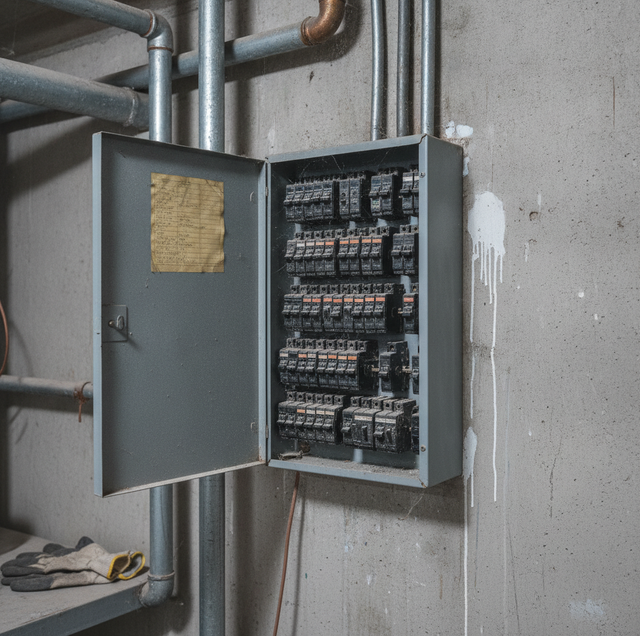
"Do I need a 200-amp panel upgrade?" The honest answer is not "always, and soon." It depends on two numbers: what your electrical service can actually supply, and what you are asking it to run. Plenty of homes on 100-amp service power a modern kitchen, a laundry, and central heating without ever brushing their limit. Others hit the ceiling the moment a second large load goes in. Age alone does not decide it, and neither does a panel that looks full. The real question is whether the capacity coming into the house still has headroom for the loads you have now and the ones you are planning.
Get that framing right, and the decision stops being a guess. An electrician sizes a service the same way every time: add up the loads the way the calculation requires, compare the total to what the service rating allows, and see whether the gap is comfortable or gone. This piece walks through that logic so you can tell which side of the line your house sits on before anyone quotes the work.
Amps on the Panel Are Not the Same as Amps at the Service
Two amperage numbers get mixed together, and separating them clears up most of the confusion.
The first is your service rating: the current the utility and your service entrance conductors are built to deliver, capped by the main breaker at the top of the panel. A 100-amp service means the main breaker is a 100-amp breaker, and everything downstream shares that ceiling. The second number is the panel's own busbar rating, the metal bars the breakers clip onto. A panel can be rated for 200 amps of busbar while still fed by a 100-amp main, which is common when only the box was replaced, and the service was left alone.
Then there are the slots, the physical spaces the breakers snap into. Running out of slots is not the same as running out of amps. A panel can be packed full of breakers and still be nowhere near its capacity, because most of those circuits draw only a little most of the time. The reverse is also true: a half-empty panel on an undersized service can be maxed the day you add one large appliance. So "my panel is full" and "my service is out of capacity" are different problems with different fixes. Upgrading to a 200-amp service raises the ceiling. Adding room for circuits, by contrast, may only need a different breaker or a subpanel.
How the Loads Actually Add Up
A service upgrade is a capacity decision, so it comes down to a load calculation. This is not a matter of summing every nameplate rating in the house, because your dryer, range, water heater, and heat pump almost never all run at full tilt in the same minute. The calculation an electrician runs applies demand factors: the general lighting and receptacle load for the square footage, the fixed appliances, and the largest heating or cooling load, each weighted by how realistically they coincide.
What has changed is the size of the new loads people add. A few of them move the needle hard:
- A Level 2 EV charger is a large continuous load, often on a 40- or 50-amp circuit, and continuous loads are counted at 125 percent of their rating because they run for hours at a time.
- A heat pump adds a substantial load that works both directions of the year, heating through the cold months and cooling through the warm ones, so it is not a seasonal add you can discount.
- An electric range and an electric dryer are each sizable dedicated circuits in their own right.
- A hot tub, a shop subpanel, an accessory dwelling unit, or a detached-garage feeder each stacks another block of demand onto the same service.
Add two or three of those to a house wired for a lighter era, and a 100-amp service that was once comfortable can run out of room. The trigger is the loads, not the calendar. A 40-year-old service running a modest set of circuits may be fine, while a 15-year-old 100-amp service asked to take on an EV charger and a heat pump may not be.
A Framework for Deciding
Rather than lean on a single warning sign, weigh your whole situation against what the service can carry. The table sorts the common cases.
| Your situation | Current service may be fine | Points to a 200-amp upgrade |
|---|---|---|
| The load you are adding | One moderate circuit, and a load calculation shows headroom | An EV charger plus a heat pump, or an ADU or shop feeder |
| Panel capacity | 100-amp main with a light, stable set of circuits | 100-amp (or 60-amp) main is already near its calculated limit |
| Open positions | Room for the breakers you need, or a subpanel, solves it | No slots left, and the service itself is at capacity |
| Main breaker behavior | Branch breakers occasionally trip on their own circuit | The main breaker itself trips under normal whole-house use |
| Panel hardware | Modern panel, sound bus, no heat or corrosion | Fused service, or a panel brand flagged as a hazard |
| Future plans | No major electrification planned | Staged plans for EV, electric heat, or an addition |
Read across your row. If most of your answers land in the middle column, a full-service upgrade may be premature, and a smaller fix could carry you. If they sit in the right column, the ceiling is the constraint, and raising it is the honest solution rather than something to work around.
Signs the Service Itself Is Maxed Out
A few symptoms point past a single circuit to the whole service.
The main breaker trips. Branch breakers trip on overloads or faults on their own circuit, which is normal and local. When the main breaker at the top opens under ordinary combined use, the whole service is being asked for more than it can supply. That is a capacity signal, not a nuisance.
There are no open slots and no easy way to make room. If every position is used, some already doubled up, and the loads you still need to add are large, you are short on both space and, often, headroom.
You are stacking major loads. The clearest sign is planned rather than symptomatic: you are about to add an EV charger, convert to a heat pump, finish a basement, or build an accessory unit. Any one of those might fit; two or three together are what tip a 100-amp service over.
Heat, buzzing, or a scorched smell at the panel is a different issue. That points to a loose connection or a failing breaker and needs attention regardless of amperage; it does not, by itself, mean you need more capacity. In a damp climate, corrosion at the connections can add to it, which is a repair question rather than a sizing one.
When 100-Amp Service Still Has Room, and When It Doesn't
It is worth saying plainly that 100-amp service is not obsolete. A home with gas heat, a gas range and dryer, and a normal set of lighting and outlet circuits can live within 100 amps for a long time, and a load calculation will show it. Upgrading such a house to 200 amps for its own sake buys headroom it may never touch.
The other side is just as real. The same 100-amp service becomes the bottleneck the moment the house electrifies. Swap gas heat for a heat pump, add a Level 2 charger in the garage, and put in an induction range, and the calculated load climbs toward or past the ceiling. At that point, the service rating, not any single appliance, is what limits you, and 200 amps is what restores the margin. The deciding factor is which direction your loads are heading, and a load calculation is what turns that into a number instead of a hunch.
What a Service Upgrade Actually Involves
Upgrading to 200 amps is more than swapping the box on the wall, which is why it takes utility coordination and an inspection. The work usually touches the whole service path:
- The meter base is replaced with one rated for the higher service.
- On an overhead service, the mast and weatherhead, the pipe and fitting that carry the wires up to the utility drop, are upsized to match.
- The service entrance conductors, the heavy cables running between the meter and the main breaker, are replaced with a gauge rated for 200 amps.
- The main panel is replaced with a 200-amp panel, and the grounding and bonding, the ground rods, and the water-pipe bond that give a fault a safe path back, are brought up to current standards.
- The utility has to disconnect the drop or the underground feed so the crew can work, then reconnect and re-meter afterward, and an inspection typically has to pass before power is restored.
That coordination is why a service upgrade is scheduled rather than same-day, and why it is different in kind from adding a circuit. It also explains why a panel that was once left "200-amp ready" still needs the utility side finished before the rating means anything.
What the Decision Comes Down To
Whether you need a 200-amp panel upgrade is a question about margin, not age. If a load calculation shows your service still has comfortable headroom for what you run and what you plan to add, you can hold where you are, and a subpanel or a breaker change may cover a slot shortage. If the calculation shows the ceiling is close or already reached, especially with an EV charger, a heat pump, or an added dwelling in the plan, then raising the service is the fix that actually addresses the constraint. The way to know is to have the loads properly added up and set against the rating, rather than relying on the number stamped inside the panel or the year the house went up.
Frequently Asked Questions
Not on its own. A panel out of open slots can sometimes gain room with tandem breakers (also called half-size or duplex breakers) where the panel is listed to accept them, or with a subpanel fed from one spare double-pole space. Both add circuits without touching the service rating. A service upgrade is warranted only when a load calculation shows the total demand, not the number of breakers, has reached the main's limit. A full panel is a space problem first; capacity is a separate test.
Often, yes. Many 100-amp homes take a Level 2 charger once a load calc confirms the headroom, sometimes on a smaller circuit, a 30- or 40-amp charger rather than a 50. Where the math is tight, a load-management device, such as an EV energy management system or a circuit-sharing setup that pauses the charger while the dryer or range runs, can let the charger share existing capacity instead of forcing a service upgrade. The charger's rated amperage and your calculated load together decide it.
200 amps is sufficient for most fully electrified single-family homes. A large house running two heat pumps, more than one EV charger, a pool, and a shop can exceed even that, which is where a 320-amp meter (rated for 400-amp service, often split into two 200-amp panels) comes in. That is uncommon for an average home, but worth a load calculation if you are electrifying heavily or building large. The number is set by demand, not by reaching for the biggest option available.
A typical residential swap runs a few hours to most of a day. Power is off for the working portion because the utility disconnects the service first, and it usually stays off until the inspection passes and the utility reconnects. Overhead-to-underground conversions, a meter that has to be relocated, or a panel that has to move all add time. Your electrician schedules the utility disconnect and the inspection together so the outage window is as short as the job allows.
Sometimes, but not always, so diagnose before you spend. If lights dim only when a big load kicks on and the service is at its limit, more capacity helps. But flickering across the whole house often traces to a loose neutral or a failing main connection, and lights that flicker on one circuit usually mean a loose device or a shared neutral there. Corrosion at an outdoor or garage connection in a wet climate can mimic a capacity problem, too. A 200-amp service does nothing for a loose connection, so the cause has to be found first.
Not automatically on age alone. A sound 100-amp panel, even with a modest load, can keep working for years. Two things change the answer: a fused service (screw-in fuses instead of breakers) or a panel brand that has been flagged as a fire or failure risk should be evaluated regardless of amperage, because the concern there is the equipment, not the capacity. And a 60-amp service is tight for almost any modern all-electric plan. If either applies, the upgrade is really about safety and reliability, and the added capacity comes along with it.
Not sure if your service has room for what you are planning? Book a load calculation and service evaluation before you commit to the work. Safeline Electric serves Vancouver, Camas, Battle Ground, and the surrounding Clark County and Southwest Washington area. Call (360) 505-0663.
