
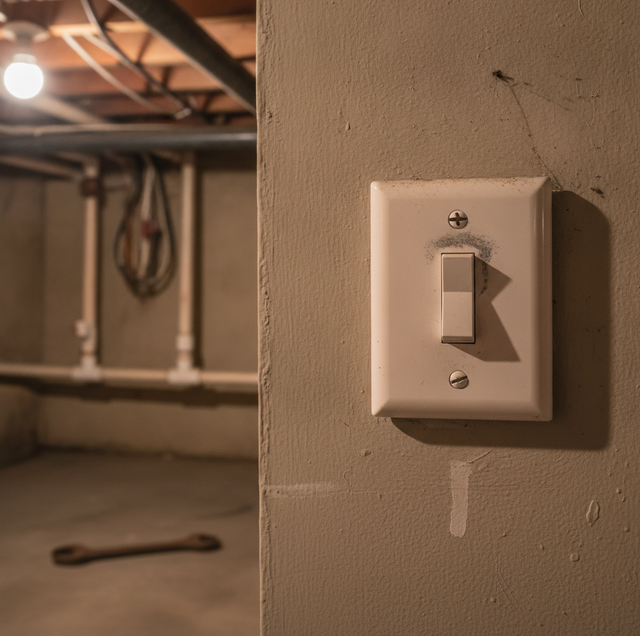
You walk past the outlet behind the couch and catch it for a second: a faint, sharp smell, part hot plastic and part fish, that fades when you step back and returns when you lean in. Maybe it is a switch instead, a little warm under your fingers, with a smudge of gray around the screws that was not there before. Nothing is smoking. Nothing looks wrong from across the room. That thin, chemical odor is the part that matters, because it almost always means a connection somewhere behind that cover plate is running hot enough to cook the plastic around it. Here is what to do, in order, before you do anything else.
What to Do Right Now
Work through these steps in order. The odor means heat is building where you cannot see it, so the goal is to cut power to that spot and keep the situation from getting worse while you get a pro on the way.
- Stop using the outlet or switch: Do not plug anything else in, and stop flipping the switch on and off to test it. Every time current runs through a bad connection, it heats up again.
- Unplug whatever is on it: Pull the cords from that receptacle, especially anything with a heavy draw like a space heater, a window AC unit, a hair dryer, or a microwave. Removing the load immediately takes the strain off the connection.
- Switch off that circuit at the panel: Find the breaker that feeds the outlet or switch and flip it fully to OFF. If your panel labels are vague and you cannot tell which breaker it is, shut off the main breaker to kill power to the whole home until you know more.
- Do not use water: Never splash or spray water at an outlet, a switch, or anything that smells like it is burning. Water conducts electricity and can turn a hidden hot spot into a shock or a larger fire. If you keep a fire extinguisher, it should be a Class C or ABC unit rated for electrical fires, not water.
- Watch for smoke, heat, or scorching: Keep an eye and a nose on the spot after the power is off. Look for a brown or black halo on the cover plate, a warped faceplate, or a plate that is still warm. Do not pry the cover off or poke at the wiring yourself.
- Call a licensed electrician: A burning smell is a diagnostic job, not a parts swap you guess at. An electrician can open the device, find the connection that is overheating, and correct it. Leave the circuit off until they arrive.
- If you see smoke, sparks, or flame, get everyone out and call 911: Do not wait to see whether it spreads. Once there is visible smoke or fire, it is a fire emergency first and an electrical repair second.
An overheating outlet or switch is a real fire risk, and the most dangerous heat is the part you cannot see. The connection that is cooking may sit inside the wall box or a few inches back in the cable, where charring can smolder in the framing long before anything shows on the surface. Turning off the breaker removes the energy feeding that heat. Do not keep using a circuit that smells hot on the theory that it worked yesterday, and do not rely on a faceplate feeling cool, since the worst of the heat is often behind it.
What That Burning Smell Actually Means
Household wiring devices are built from thermoplastic and nylon, and those materials have a distinct odor when they get too hot. The sharp, fishy note people describe is the smell of that plastic being overheated, sometimes with a whiff of the flame-retardant compounds baked into it. In other words, the smell is not the wire itself. It is the housing around the connection heating up because the connection has gone bad.
Almost every version of this traces back to a high-resistance connection, meaning a spot where electricity has to squeeze through more resistance than it should. Resistance turns into heat, and heat is what you are smelling. A few things commonly cause it:
- A loose termination: A wire that was not tightened firmly under a screw, or that has worked loose over years of heating and cooling, makes poor contact. Current jumping that tiny gap is an arc fault, and arcing runs extremely hot in a very small area. This is the most common cause behind a smell with no obvious damage yet.
- A backstabbed receptacle: Many outlets have push-in holes on the back, called backstab connections, where the wire is held by a small spring clip instead of wrapped under the side screw. Those clips loosen over time and are a frequent source of overheating on older devices. Moving the wires to the screw terminals is a standard fix an electrician will reach for.
- An overloaded receptacle: A 15-amp outlet asked to carry more than it is rated for, often through a daisy chain of power strips or two heat-producing appliances at once, runs hot even when every connection is tight. The device is simply passing more current than it was built to handle.
- A failing device: Outlets and switches wear out. The metal contacts inside lose their spring tension, arc against a loose blade, and pit and char. A switch that buzzes, feels warm, or smells hot is often worn out inside, and no amount of tightening will save it.
Damp conditions make all of this worse. Moisture that enters an outdoor receptacle, a garage outlet, or a crawlspace box corrodes the contact points, and a corroded connection is high-resistance. That is why exterior and wet-area circuits tend to act up, whatever the time of year.
Why the Smell Can Come Before Anything Looks Wrong
The reason a burning outlet is dangerous is that the warning arrives quietly. You get the odor of hot thermoplastic well before you get scorch marks, and scorch marks well before anything sparks. By the time a faceplate is visibly browned or a switch is hot to the touch, the connection has been cycling hot for a while, and the heat has had time to work into the wire insulation and the wood of the box or stud.
This is also why an arc-fault breaker matters. An AFCI breaker senses the electrical signature of arcing, the same loose-connection arcing that produces the smell, and trips before it starts a fire. Homes with older wiring often lack that protection on every circuit, so the human nose ends up being the smoke detector. A smell you can identify is a warning worth acting on.
Acting on the Smell Before It Escalates
A faint hot-plastic or fishy smell at an outlet or switch is your early warning that a connection is overheating, and the safe response is simple: stop using it, pull the load, kill the breaker, keep water away, and get an electrician to find the spot. The repair itself is usually small once someone can see it: a re-terminated wire or a replaced device. The danger is not the fix. It is treating the smell as something that will sort itself out, while heat keeps building where you cannot watch it.
Frequently Asked Questions
No, it means you removed the load, not the fault. The connection that overheated is still loose or worn, and it will run hot again the next time that circuit carries a real draw. Unplugging buys you safety for the moment, but the underlying device or termination still needs to be opened up and corrected. Leave the breaker off and have it looked at rather than plugging back in once the smell fades.
Yes, and sometimes more so. A switch has moving contacts inside that arc a little every time you flip it, so worn or loose switch contacts are a classic overheating point, especially on a switch controlling a heavy load like a bank of lights or an in-wall heater. A dimmer running hot is its own case, since an undersized dimmer driving more wattage than it is rated for will heat up by design. Treat a hot or smelly switch exactly like a hot outlet.
The part is cheap, but the reason it failed is what matters, and that is the part a swap can miss. If the real problem is a loose wire deeper in the box, an overloaded circuit, or aluminum branch wiring that needs special connectors, a new outlet on the same bad connection will overheat again. An electrician confirms the cause, checks the wire for heat damage, and uses the correct terminations rather than guessing.
Brown or black staining around the slots, a melted faceplate, or a plate warped out of square all mean the device has been running hot for some time, not just today. At that stage, the device is done, and the wiring behind it needs inspection for heat-damaged insulation. That char is evidence of past arcing, not cosmetic dirt to paint over.
That usually points to the wiring or the device itself rather than a load you added. An outlet is often wired into a run that feeds other outlets downstream, so current to those can pass through its terminals even when its face is empty. A loose feed-through connection there heats up while carrying that pass-through load, which is why an unused outlet can still smell hot. It is a strong sign that the connection, not the appliance, is the problem.
Just the one circuit is enough if you can identify it with confidence, since that isolates the problem while leaving your refrigerator, lights, and everything else on. Shut off the main only when your panel is unlabeled, and you cannot tell which breaker feeds the outlet, or when the smell is strong and you want everything dead until help arrives. If you flip a breaker and are not sure the right circuit went cold, plug a lamp into the outlet to confirm it has no power before you trust it.
If an outlet or switch smells like it is burning, cut power to that circuit and have it inspected before you use it again. Safeline Electric serves Vancouver, Camas, Battle Ground, and the surrounding Clark County and Southwest Washington area. Call (360) 505-0663.
