
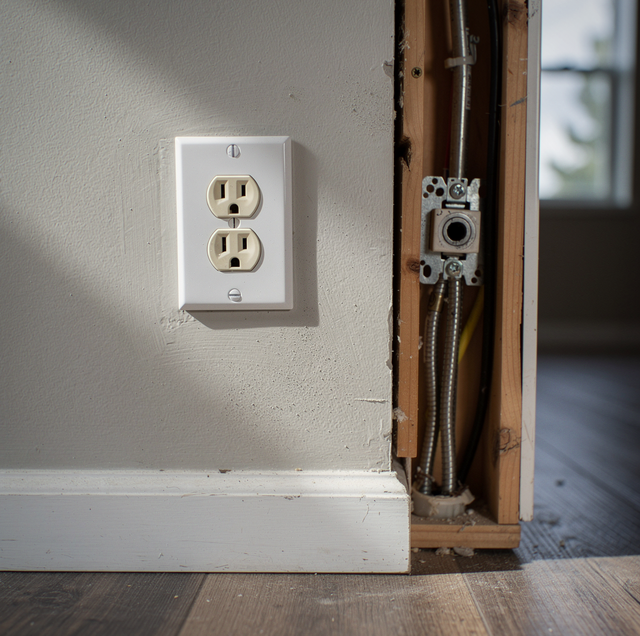
Pull an outlet out of the wall in a home built between about 1965 and 1973, and you might find wire jacketing stamped "AL" or "Aluminum" instead of the familiar copper color. Ask around, and you'll likely hear that the whole house needs to be gutted and rewired before it burns down. That story skips past a narrower, more useful fact: the real risk lies in a specific kind of connection, not in every aluminum conductor in the house, and a licensed electrician has more than one way to fix it without opening every wall.
Myth: any aluminum wire in a house is a hazard that has to be torn out.
Reality: the trouble is almost always at small-gauge branch-circuit aluminum feeding outlets, switches, and light fixtures, wired directly to devices that were never designed to hold aluminum in the long term. Larger aluminum feeder and service-entrance cable, the kind that runs from the meter to the panel or feeds a range or dryer, behaves very differently and is still installed in new construction today.
Why Aluminum Behaves Differently Than Copper at a Connection
Copper and aluminum are both good conductors, but they don't behave the same way in a wall. Aluminum expands and contracts more than copper with every heating and cooling cycle a circuit goes through, and under the sustained pressure of a screw terminal, it also slowly deforms rather than springing back, a behavior electricians call cold creep. Each cycle leaves the connection a little looser than before.
A loose connection is a small-area contact that carries the same current as a snug one, so the resistance at that single point increases. Resistance converts electrical energy into heat, so the loose spot runs warmer than the rest of the circuit whenever a load turns on. Aluminum also forms a thin oxide layer on exposed surfaces almost as soon as it's cut, and that oxide is a poor conductor, adding still more resistance right where the connection needs it least.
Put a loosening connection and a growing oxide layer together at the same screw terminal, behind a wall, inside a switch box, or under a wire nut, and you have a spot that heats every time the circuit is used, cycle after cycle, for years. That's the mechanism behind the scorched outlets, discolored cover plates, and warm switch plates that show up in older aluminum-wired homes. It isn't the aluminum itself failing; it's the connection around it losing contact quality over time.
Moisture Adds a Second Failure Path
Where an aluminum-wired outlet is located in a garage, a crawlspace, or on an exterior wall, a second mechanism joins the first. Two different metals in contact, aluminum wire against a brass or steel terminal, form a galvanic pair once moisture bridges them, and the more active metal corrodes faster than it would sitting dry. That corrosion product occupies space at the contact point, pushing the connection farther from solid metal-to-metal contact and adding even more resistance on top of what cold creep and oxidation have already produced. In a region where damp crawlspaces and unheated garages are a normal part of the housing stock, that combination is why aluminum-wired devices in unconditioned spaces tend to show signs of heat and corrosion earlier than the same wiring type feeding a dry interior room.
Where the Risk Actually Concentrates
Three things narrow the risk down from "the whole house" to a specific, findable set of connections.
Wire gauge and era: The problem branch-circuit wiring is typically 12 or 10 AWG solid aluminum installed during the copper price spike of the late 1960s and early 1970s, feeding standard 15- and 20-amp outlets, switches, and light fixtures.
Device compatibility: Ordinary outlets and switches from that era were built and rated for copper. Aluminum wire connected directly to a device that isn't rated for it is where the heating happens. Devices marked CO/ALR (copper/aluminum revised) use a different terminal alloy and coating designed to resist cold creep and oxidation, and they can accept aluminum wire directly.
Connection type: A back-stabbed (push-in) connection, common on cheap devices of that period, relies on spring tension alone and is the weakest fit for aluminum. A screw terminal is somewhat better. A properly made splice using a connector rated for aluminum-to-copper is the strongest of the three.
Feeder and service-entrance aluminum, by contrast, uses larger conductors (often 4 AWG and up) connected with lugs rated for aluminum, torqued to a specific spec, and typically re-torqued or inspected during any panel service. The larger cross-section moves less per degree of temperature change relative to the connection surface, and the lugs are engineered for the metal. That's why aluminum feeders and range or dryer circuits remain a normal, code-accepted part of new electrical work, while the small-gauge branch wiring from the 1960s and '70s is the group that draws scrutiny.
The Three Ways to Actually Fix It
An electrician evaluating aluminum branch wiring generally has three paths, and the right one depends on the home's wiring layout, the number of affected devices, and how much of the wall the owner is willing to open.
| Repair Method | What It Involves | Where It Fits Best |
|---|---|---|
| Pigtail with a rated splice connector | A short length of copper wire is spliced onto the end of each aluminum conductor at the device box using a connector engineered and listed for aluminum-to-copper joints (often filled with an anti-oxidant paste); the device then connects to the copper pigtail instead of the aluminum directly | Most common repair; works box by box without opening walls, and can be done room by room over time |
| Permanent crimp splice | A specialized, high-pressure crimp sleeve permanently joins the aluminum conductor to a copper pigtail using a proprietary tool; considered by federal safety researchers to be a lasting fix when done correctly | Fewer electricians carry the certification and tool for this method, so availability varies by area |
| Full rewire | All aluminum branch circuits are replaced with copper from the panel to the devices | Homes already undergoing a remodel, additions with limited existing aluminum runs, or owners who want the wiring type eliminated rather than managed at each connection |
Whichever method a home ends up with, an anti-oxidant compound at any aluminum-to-copper joint is part of doing the splice correctly. The compound doesn't fix a loose connection on its own, but it slows the oxide growth that makes a marginal connection worse over time, which is why it's applied at the splice rather than sold as a stand-alone fix.
What an Electrician Checks Before Recommending a Path
A safety evaluation of aluminum-wired branch circuits typically starts with the panel, checking whether the breakers and lugs there are rated for aluminum and torqued to spec, since a loose main lug can run just as hot as a loose outlet. From there, an electrician opens a sample of outlet, switch, and fixture boxes to look at wire condition, check for existing back-stab connections, and note any signs of past heating: discoloration on the wire jacket, a brittle or crumbling feel to the insulation, or scorch marks on the box itself. A thermal camera pass while a few high-draw circuits are running can flag a hot connection well before it becomes visible as a warm cover plate.
That inspection is what turns "the house has aluminum wiring" into a specific list of devices and connections that need pigtailing, plus a note on any that are already showing heat damage and need priority attention.
Priority Order When Not Every Connection Can Be Done at Once
A home with dozens of aluminum-wired devices rarely gets pigtailed in a single visit, so an electrician typically triages the work. High-draw, continuously loaded circuits go first: kitchen small-appliance circuits, the laundry circuit, and any outlet already showing discoloration or a warm cover plate. A ceiling fixture on a lightly used spare-room switch carries far less risk than a kitchen counter outlet that runs a coffee maker and a toaster every morning, so the schedule follows actual use, not just which room happens to be opened up first.
Panel-level connections get checked early in the same visit for a related reason. A branch breaker terminal holding an aluminum conductor is subject to the same cold creep as an outlet screw, and because every circuit passes through the panel, a loose lug there affects everything downstream. Confirming those terminals are torqued to spec is a quick check that rules out the highest-consequence connection in the house before moving on to individual rooms.
Frequently Asked Questions
Look at the conductor itself if a cover plate is already off: aluminum has a dull, matte gray color. It feels stiffer than copper's shiny reddish-orange, so it's identifiable by look and feel even where an "AL" stamp has worn off or was never legible. A home inspection report or the seller's disclosure from the last time the house sold, if you kept a copy, is also worth checking, since aluminum branch wiring is a standard flagged item on that paperwork in older homes and can save a visual check altogether.
Some insurers ask for proof of a pigtail repair, a full rewire, or an inspection report before writing or renewing a policy for a home with known aluminum branch circuits, though the requirements vary by carrier and state. Reading the policy's wording or asking the agent directly is the only way to know how a specific carrier handles it.
Yes. The service feeder and branch-circuit wiring are separate questions. A new 15- or 20-amp copper branch circuit added to a panel fed by aluminum service cable is routine work, as long as the panel's lugs and breakers are the type rated for the feeder's conductor material and properly torqued.
Only with a connector specifically engineered and listed for joining aluminum to copper, filled with an anti-oxidant compound. Twisting bare aluminum and copper together under an ordinary wire nut skips that protection and sets up galvanic corrosion between the two metals, which speeds up the same oxidation problem the repair is meant to stop.
A properly installed pigtail splice using a listed connector is intended as a long-term fix, not a temporary patch, and many have held up for decades in the field. A full rewire removes the aluminum-to-copper interface entirely, so there is nothing left to monitor at that connection; a pigtailed home still benefits from periodic checks of a few splices during routine electrical service.
The device itself (the outlet, switch, or fixture) is usually left in place or swapped for a standard new one, since the copper pigtail is what the device actually connects to once the splice is made. The aluminum conductor never touches the device terminal directly after the repair, which is the entire point of the pigtail.
Aluminum wiring earns a reputation as an automatic hazard because the failures it produces- warm plates, faint odors, flickering circuits- are the same signs a house shows for other wiring problems entirely. What actually separates a manageable aluminum branch circuit from a dangerous one is the condition of its connections, not the metal running through the wall. A trained eye on those connections, and a repair matched to what's actually found, does more for safety than tearing out wire that was never the problem in the first place.
Schedule an aluminum wiring safety evaluation — get a room-by-room check of your outlets, switches, and panel connections, with a clear repair plan for anything found. Safeline Electric serves Vancouver, Camas, Battle Ground, and the surrounding Clark County and Southwest Washington area. Call (360) 505-0663.
