
Why LED Lights Buzz or Hum and When to Worry
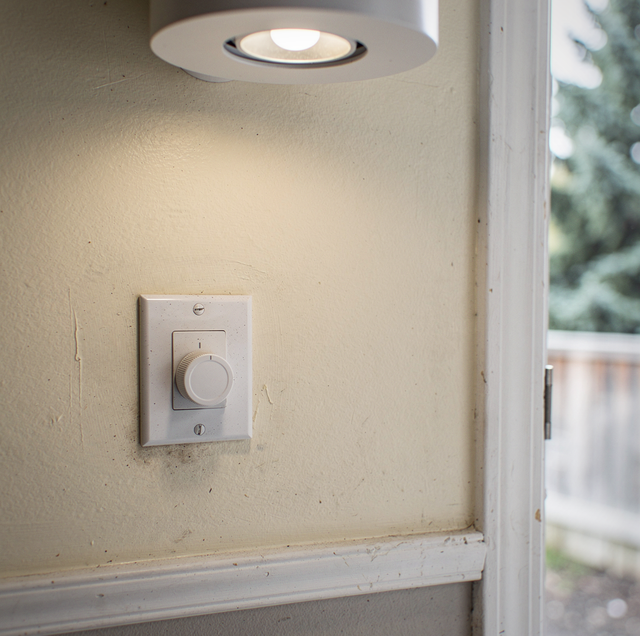
A dimmed LED bulb that hums under its breath isn't broken, and the sound isn't coming from where most people assume. Almost always, it's coming from tiny components inside the bulb's driver circuit, not the diode itself, a byproduct of how that driver converts household power down to what an LED actually needs. Whether it's worth worrying about depends on where the sound is actually coming from and whether it changes as you move the dimmer, both of which this article walks through.
What's Actually Making the Sound
An LED chip runs on low-voltage direct current, nothing like the 120-volt alternating current coming out of your wall. Every LED bulb or fixture has a built-in driver (or a nearby one for hardwired fixtures) whose job is to convert the incoming AC power into the steady, regulated low-voltage DC the diode needs. Cheap drivers and even some quality ones do that conversion with a switching power supply operating at a frequency well above what you'd normally hear, tens of thousands of cycles per second, using small components: miniature transformers, inductors, and ceramic capacitors.
Those components can vibrate at audible frequencies through two related effects: magnetostriction, where a magnetic core in a transformer or inductor physically changes shape slightly as current flows through it, and a similar mechanical response in ceramic capacitors under a fluctuating voltage. Neither effect is a malfunction on its own; it's a side effect of how switching power conversion works, and it becomes audible when the component's vibration happens to fall within a frequency range that human ears can hear.
Why Dimming Makes It Worse
A standard dimmer built for old incandescent bulbs works by phase-cutting the AC waveform: it chops off a portion of each electrical cycle, so the bulb receives power only for part of the cycle rather than the whole, and a resistive incandescent filament handles that chopped waveform without complaint. An LED driver is a different kind of load entirely, and how it responds to a chopped waveform depends heavily on whether the dimmer was actually designed and rated for LED loads.
A dimmer not rated for LED bulbs feeds that chopped waveform into the driver's switching circuit, and the driver's regulation electronics can react to the abrupt on-off edges by working irregularly, drawing pulses of current that land right in the audible range. That's why the buzz frequently gets louder or changes pitch as you move the dimmer through its middle range, where the waveform is chopped most aggressively, and often quiets down near full-on, where the driver is closer to seeing a full, uninterrupted waveform.
The Minimum Load Problem
Dimmers built for incandescent bulbs are also engineered around a minimum load wattage, often around 40 watts, to keep their internal switching circuit stable. An incandescent fixture easily clears that bar with a single bulb. An LED fixture typically doesn't: a handful of LED bulbs replacing those same sockets might draw a combined total well under the dimmer's minimum, since an LED produces the same brightness on a fraction of the wattage. Fall under that threshold, and the dimmer's own circuit can become unstable, producing a buzz that has nothing to do with the LED driver at all and everything to do with the dimmer not seeing enough load to regulate properly.
Two fixes address that specific cause: adding a small "bypass" device, essentially a dummy load wired in to satisfy the dimmer's minimum without adding usable light, or swapping in a dimmer built specifically for low-wattage LED loads, which is designed around a much lower minimum threshold from the start.
When the Buzz Points to Wiring, Not the Bulb or Driver
A driver or dimmer hum is a steady, fairly quiet electronic tone that typically changes character as you adjust brightness. A buzz that stays constant regardless of the dimmer position, that's noticeably louder than a typical driver hum, or that seems to come from inside the wall or the switch box rather than the fixture itself, is a different problem: a loose connection somewhere in that circuit vibrating at the ordinary 60-hertz rate of household current. A loose wire nut, a backstabbed connection working its way free, or a loose screw terminal at the switch can produce a mechanical hum through the same arcing-and-vibrating mechanism that causes a loose connection to heat up. That version warrants an electrician's prompt attention, since it shares a cause with connections that eventually overheat, not because the sound itself is dangerous.
Why the Same Bulb Sounds Louder in Some Fixtures Than Others
The same LED bulb can hum quietly in an open table lamp and sound noticeably louder in a recessed can light or an enclosed globe fixture. That's not the bulb behaving differently; it's the fixture acting like a small soundboard. A metal can housing or a sealed glass globe gives the driver's vibration a hard surface to couple to and a partially enclosed cavity to resonate within, for the same reason a guitar body makes a plucked string louder than the string alone would ever sound. An open fixture with nothing rigid touching the bulb lets far more of that vibration dissipate before it becomes audible. Swapping a buzzing bulb from an enclosed recessed fixture into an open lamp socket, even temporarily, is a quick way to confirm whether the fixture itself is amplifying a hum that would otherwise go unnoticed.
Sorting Out Which Cause You Have
| What You Notice | Likely Cause | What Helps |
|---|---|---|
| Hum changes pitch or volume as you move the dimmer | Dimmer and driver phase-cutting mismatch | Swap to a dimmer rated for LED loads |
| Buzz appears only with a few low-wattage LED bulbs on a dimmer | Dimmer's minimum load not being met | Add bulbs, add a bypass device, or use a low-wattage-rated dimmer |
| Hum is steady, faint, present even on a full-on switch (no dimmer) | Driver's internal switching components | Usually harmless; a different-brand bulb or fixture may run quieter |
| Buzz sounds like it's coming from the wall or switch box, doesn't change with dimming | Loose connection at the switch, junction box, or fixture | Have the connection checked; don't ignore it |
Frequently Asked Questions
Not on its own. Driver hum and remaining bulb life aren't directly linked; a bulb can buzz quietly for its entire working life without failing early, or run silently and still fail on a normal schedule. The buzz is a byproduct of the driver's switching electronics, not a wear indicator.
Generally, no. Smart bulbs handle their own dimming digitally through their app or hub and are designed to be wired to a standard, always-on switch, not a physical dimmer. Running a smart bulb through a physical dimmer at the same time creates two separate systems trying to control brightness, which often results in buzzing, flickering, or the bulb not responding correctly to either control.
Yes, and it's the cheaper test to try first. Driver quality varies noticeably between manufacturers even at similar price points and wattage, so a bulb from a different brand can behave completely differently on the same dimmer, quiet where the previous bulb buzzed, simply because its driver's switching circuit responds better to that particular chopped waveform.
It's a small module, often about the size of a nightlight, that plugs into an unused outlet on the same circuit or wires into the fixture's junction box, and it draws a small, fixed amount of power continuously. That constant draw is enough to keep the dimmer above its minimum load threshold, resolving buzzing and flickering caused specifically by an under-loaded dimmer without changing anything about the LED bulbs themselves.
It's uncommon, but a breaker nearing the end of its life can produce a faint hum of its own, distinct from the fixture. If the hum seems to follow you to the panel rather than staying at the light fixture when you walk between the two, that's worth mentioning to an electrician as a separate item to check, since a humming breaker is a different investigation entirely.
Yes. "Dimmable" on the packaging means the driver is built to accept a dimmed signal, not that it will run quietly or smoothly on any dimmer already installed in the wall. Pairing a dimmable LED fixture with an LED-rated dimmer, rather than assuming any working dimmer will do, is what actually avoids the mismatch that causes most of this buzzing in the first place.
Most LED buzzing traces back to a mismatch between a driver's switching electronics and whatever dimmer or load it's paired with, not a defect in the bulb itself, and the fix is usually a compatible dimmer, an added bulb or two, or a small bypass device rather than a repair. The one version worth treating differently is a buzz that stays put in the wall regardless of what you do at the switch, since that's a connection working itself loose rather than a driver doing its job a little noisily.
Get your dimmers, fixtures, and wiring connections checked for LED compatibility — a full diagnosis pinpoints whether a dimmer swap or a loose connection is behind the buzz. Safeline Electric serves Vancouver, Camas, Battle Ground, and the surrounding Clark County and Southwest Washington area. Call (360) 505-0663.
