
Whole-House Surge Protectors: Do You Need One?
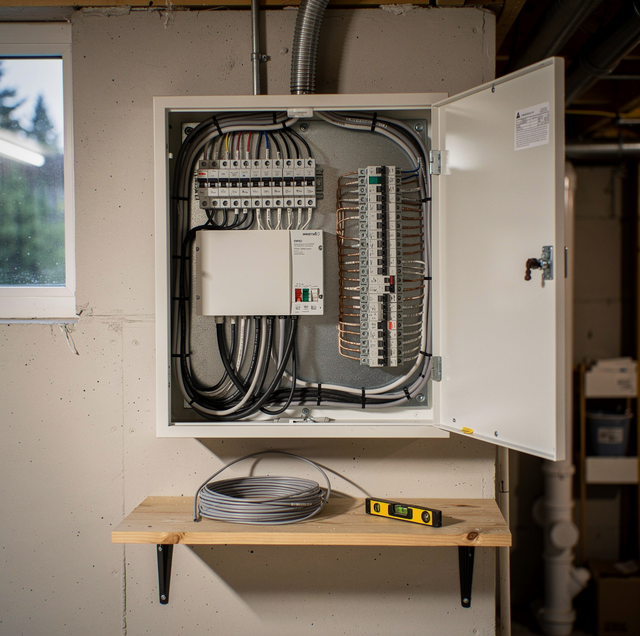
Rather than starting from what a surge protective device is, start from five questions about your own house. The answers point straight to whether the device earns its place on your panel, and along the way you'll learn exactly how it works and what it can't do.
Question 1: Does Your Home Run Large Motors That Cycle On and Off?
A refrigerator compressor, a well pump, a garage door opener, a heat pump, and a pool or hot tub pump all share one trait: an electric motor that draws a burst of current at startup and dumps stored energy back onto the wiring the instant it shuts off. That release is a small, sharp voltage spike, an internal surge, and it happens every single time one of those motors cycles, dozens of times a day in a home with a heat pump or a well pump running through the day and night. Most homeowners picture lightning when they think about surges, but a large share of the surge activity a house's wiring actually sees comes from inside the house, from its own equipment cycling on and off, not from the utility line or the sky.
If your home runs a heat pump, a well pump, or similar cycling equipment, you're generating small surges on your own wiring continuously, in every season, regardless of the weather outside.
Homes that have added a heat pump for heating and cooling, or an EV charger that pulls a heavy, steady load every time a vehicle plugs in overnight, add both more continuous demand on the panel and more start-stop cycling from the heat pump's compressor. Neither of those additions changes how a surge protector works, but they do raise how often the panel sees a small internal spike over the course of a year, which is one more factor worth weighing alongside the utility-side questions below.
Question 2: Does Your Utility Grid Experience Switching Events or Storm Outages?
Utilities constantly balance load across their network: capacitor banks switch in and out, substation equipment cycles, and crews restore service after an outage; each of those events can send a brief overvoltage down the line toward your house. Windstorms, ice storms, and downed lines add larger, less frequent spikes on top of that background activity, and a home's electrical panel is the point where all of it, small and large, first reaches your wiring. A region prone to windstorm-driven outages experiences a higher rate of such events, but even a quiet grid switches equipment routinely, so exposure never drops to zero.
Question 3: Do You Own Equipment With Sensitive Electronic Controls?
A television, a computer, a modern refrigerator, a furnace or heat pump control board, and a smart thermostat all rely on small electronic components rated for a narrow voltage range. Those components degrade with repeated small overvoltage events even when a spike isn't large enough to destroy the device outright in one shot; each hit shortens the component's working life a little more. A home built mostly around older, simpler appliances with no circuit boards has less at stake than one filled with networked, electronic-controlled equipment.
Question 4: Would You Notice or Care If a Device Failed Without Warning?
A surge-damaged control board rarely announces itself. The furnace simply stops responding one cold morning, or the refrigerator's compressor never restarts after a brief outage, and there's no burn mark or obvious cause to point to. If a repeat unexplained appliance failure would be a costly, disruptive surprise in your household, that's a vote in favor of protection; if you're indifferent to replacing electronics as they fail, the calculation shifts.
Question 5: Is Your Panel Already Set Up With a Verified Grounding Path?
This is the one question whose answer your own can't fully settle, because it requires a licensed electrician's inspection to confirm. A surge protective device works by diverting excess voltage into the grounding system; if that grounding system is weak, corroded, or improperly bonded, the device has nowhere to send the energy and can't do its job regardless of how good the unit itself is. Any surge protector installation should start with confirming the grounding path is sound, not with picking a product.
How the Device Actually Stops a Spike
A panel-mounted SPD sits quietly on the circuit, doing nothing at all under normal voltage. Inside it, a component (most commonly a metal oxide varistor) acts like a valve that stays shut below a set voltage threshold and snaps open the instant voltage crosses it, diverting the excess energy to the grounding system instead of letting it continue toward your outlets. A pressure relief valve on a water heater works the same way: closed during normal operation, then opens the moment pressure exceeds a danger point, venting the excess safely. The SPD does the same job electrically, in a fraction of a millisecond.
Type 1, Type 2, and the Strip Under Your Desk
Not every surge device does the same job, and picking the right layer matters as much as installing one at all.
| Device Type | Where It Connects | What It Handles |
|---|---|---|
| Type 1 SPD | Line side of the main breaker, ahead of the panel | Larger energy events arriving from outside the house, including utility switching and nearby lightning activity |
| Type 2 SPD | Load side of the main breaker, inside or beside the panel | The most common whole-house protection layer; clamps both incoming spikes that get past the service entrance and internal spikes generated by your own motors |
| Point-of-use strip | Plugged in at an individual outlet | A modest residual spike at one piece of equipment; overwhelmed quickly by a large event on its own |
None of these three replace the others. A panel device absorbs the bulk of an event and knocks it down to a much lower level, but some residual voltage still gets through, and a panel device can't stop a spike generated downstream of it, say, from a motor on the same branch circuit as your home office equipment. Pairing a Type 2 panel device with a point-of-use strip at your most sensitive gear, a media center, a home office, covers both ends: the panel handles the big hit, and the strip mops up what's left right where it matters.
Reading the Two Numbers That Actually Matter
An SPD's rating comes down to two figures worth understanding rather than memorizing. Joules describe how much total surge energy the device can absorb over its working life, the size of its tank; a higher number means it can take more hits, small and large, before it's used up. Clamping voltage (sometimes called the voltage protection rating) is the level of voltage the device still lets through while it's actively diverting a spike; a lower number means your equipment sees less leftover voltage during an event. A device that pairs a high joule rating with a low clamping voltage is doing the most complete job of the two available metrics.
The Device Wears Out, and It Fails Silently
Every surge an SPD absorbs uses up part of its internal capacity, and a single severe event can exhaust a unit in one hit. Once its protective component is depleted, the device stops working and typically remains on the panel, looking exactly like a functioning one from the outside. That's why a quality unit includes a status indicator, usually a small window or light that stays lit while the device is live and goes dark or changes color once its capacity is gone. Checking that indicator once or twice a year is the only way to know a unit that's absorbed a big event is still doing its job rather than sitting there empty.
Why the Panel-Level Device Is Licensed Work
The panel enclosure holds busbars carrying live voltage even with every branch breaker switched off, and a Type 1 or Type 2 SPD connects directly to those busbars and to the grounding system. Correct installation means the right conductors, short and straight leads for the fastest possible response time, and a verified, low-resistance path to ground, none of which is safe or appropriate as a homeowner project. The point-of-use strips at your desk or media center are the part of this system you handle yourself; the panel device is the part an electrician installs after confirming your grounding is actually sound.
Frequently Asked Questions
Many Type 2 units mount inside the panel on a double-pole breaker, occupying two slots. In a full panel, an electrician can free up space with a tandem breaker or mount the SPD in a small, separate enclosure beside the panel with its own disconnect, so a full panel doesn't rule out the option.
Yes, and it's worth considering wherever a subpanel feeds its own motors and equipment, a workshop, a detached garage, or an addition, since those loads generate their own internal surges independent of whatever protection exists at the main panel.
No. An SPD reacts only to a voltage spike; it has no role during a voltage drop or a full outage, and it won't keep anything running. A battery backup or an uninterruptible power supply solves that separate problem, and sensitive equipment sometimes benefits from both.
Yes. The transition when a transfer switch moves a home's load from utility power to a generator, and back again once utility power returns, can produce its own brief voltage transient distinct from a lightning-driven or utility-driven surge, which is one more reason a panel-level device earns its keep in a home that also runs backup power equipment.
There's no fixed lifespan; longevity depends entirely on how many surge events, small and large, the device absorbs over time. Because the indicator light is itself a small electronic component that can fail quietly, many manufacturers publish a suggested proactive replacement interval, often in the 5 to 10 year range, as a backup to relying on the light alone. Pairing that manufacturer interval with the indicator check during a routine electrical service is what catches the rare case where a spent or failed unit still looks fine at a glance.
No. An SPD is matched to a specific voltage system and panel configuration during installation, and moving one to a different property means starting over with a fresh evaluation of that home's grounding, panel type, and service configuration rather than reusing the old unit's rating as a given.
Five questions, not a sales pitch, are what actually settle whether a surge protector belongs on your panel: how many motors cycle in your house, how exposed your grid is to switching events, how much sensitive electronics you're running, how much an unexplained failure would cost you in disruption, and whether your grounding path can even support the device doing its job. Answer those honestly, and the decision mostly makes itself.
Have your grounding checked and get a surge protection recommendation matched to your panel — not a one-size answer. Safeline Electric serves Vancouver, Camas, Battle Ground, and the surrounding Clark County and Southwest Washington area. Call (360) 505-0663.
