
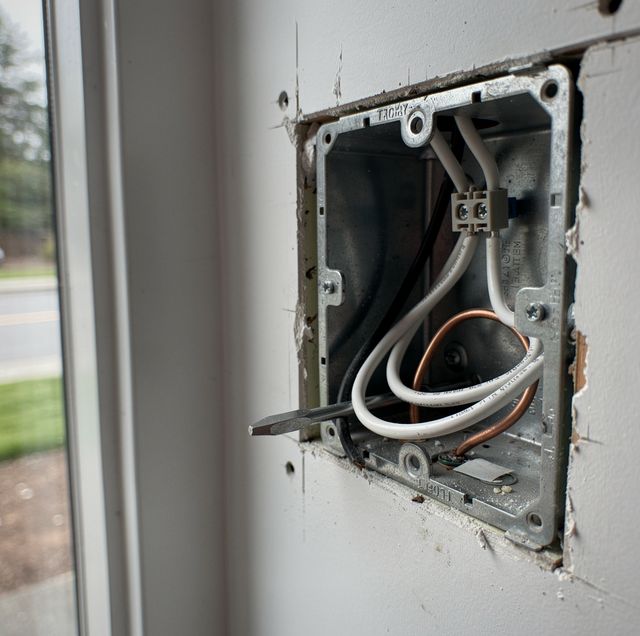
A standard wall switch is a gap in the hot wire. On, two metal contacts close and current runs to the light; off, they part. The switch uses no power in either position, so it needs only the incoming hot and the switched leg to the fixture. A smart switch is a small powered device. It holds a circuit board, a relay or semiconductor that does the switching, and a radio that listens for a phone, a hub, or a voice command. That radio has to stay awake while the light is off. Standing power needs a complete loop from the hot conductor back to the source, and the neutral is the wire that closes that loop without passing through the light.
What's behind the switch plate determines which smart switch will work. Each wiring situation in a switch box carries its own meaning for a smart switch and its own set of options:
| Situation in the Box | What It Means for a Smart Switch | Options |
|---|---|---|
| White conductors spliced together at the back, not attached to the switch | A neutral may be available once it is confirmed to belong to the same circuit | A smart switch that uses a neutral, joined to that splice with a short pigtail |
| One cable with a hot and a switched leg only, plus a ground | No return path exists at the switch | A no-neutral model on a load it supports, a new neutral run, or control at the fixture |
| Wiring older than the practice of bringing neutrals to switch boxes | The box may hold no neutral, and the old conductors may not tolerate handling | An evaluation of the wiring before any device change |
| A three-way location, with two switches for one light | The neutral may reach one of the two boxes, or neither | A main device where the neutral is, with a companion or remote at the other spot |
| A box already crowded with wires and devices | A deeper smart switch body may not fit | A larger or deeper box, or control at the fixture |
How a Neutral Keeps a Smart Switch Running
Current flows only around a complete loop. In a lighting circuit, the hot conductor carries current out from the breaker, through the switch and into the light, and the neutral carries it from the light back to the panel. A standard switch is installed on the hot side of that loop and breaks it. Once the loop is open, nothing beyond the gap has power, including anything inside the switch itself.
A smart switch gets around this by drawing its own supply between the incoming hot and a neutral landed on its own terminal or lead. That second loop runs through the switch's electronics and back to the panel without touching the fixture. The relay inside can then open the path to the light while the board, the radio, and any indicator on the paddle stay powered. The current in that standing loop is small, but it flows whenever the circuit is on, which is why a smart switch built to use a neutral will not start up without one.
Switch Loops and Boxes Without a Neutral
A switched light can be wired in two basic patterns. In the first, power from the panel arrives at the switch box, and a cable carrying the switched hot and the neutral continues up to the fixture. The neutral passes through the switch box on its way, and its white conductors are spliced together at the back of the box, clear of the switch.
In the second pattern, power reaches the ceiling box first. A single two-conductor cable then drops down to the switch, taking the hot down and bringing the switched leg back up. That drop is called a switch loop, and it leaves the neutral in the ceiling box, a few feet above the switch that now needs it.
Where neutrals are required at switch boxes is determined by the rules in force when a home was wired, and older rules did not require one. A house wired under them can mix both patterns room by room, depending on how each run was routed. A single switch box can also carry conductors from more than one circuit. The neutral used for a smart switch has to be the one that returns current for the same circuit as that switch's hot. A white wire from a neighboring circuit, spliced in the same box, is no substitute.
Three-way locations add a layer. Two switches control one light through a pair of travelers, and the neutral can land in only one of the two boxes, or in neither. Smart three-way setups on some systems put the main device in the box with line power and a neutral, and a companion unit or a battery-powered remote at the other location.
What the Electrician Finds Inside the Box
The answer sits inside the box, which puts it on the electrician's side of the plate. The breaker goes off first, and the switch is tested dead, and because one box can hold conductors from more than one circuit, every conductor is tested before any of them is handled.
With the cover off, the conductors show which pattern the box follows. A group of white wires joined under a wire connector and folded behind the switch marks a likely neutral, which still has to be traced to the switch's own circuit. A box holding one cable whose two insulated conductors both land on the switch, plus a bare ground, is a switch loop. Cloth-covered conductors mark older wiring, knob-and-tube or early cloth-sheathed cable, which needs an evaluation before anything in the box changes.
A switch box can carry a second circuit that stays live after one breaker is off, and aged insulation can crack when conductors are moved. Pulling devices, splicing a neutral, and rewiring that box are an electrician's work.
The Bare Ground Has a Different Job
The bare or green conductor beside the switch looks like a handy return path. It exists to carry fault current during a failure so the breaker trips, and running a smart switch's standing current on it puts current on metal parts that are meant to stay dead. A box with a hot, a switched leg, and a ground still counts as a box with no neutral.
No-Neutral Smart Switches and Their Limits
Some smart switches are built for boxes without a neutral. With the light off, a no-neutral switch keeps itself running by passing a trickle of current through the light and back along the fixture's neutral in the ceiling. With the light on, it takes its supply by dropping a sliver of voltage across itself. The fixture is part of the switch's power supply in both states.
That design depends on the load. An incandescent filament passes the trickle and stays dark. An LED driver can respond differently: the trickle can charge its input capacitor until the driver fires for an instant, so the fixture can glow faintly when off, blink at intervals, or flicker at low settings. A load that is too small can also leave the switch without enough current to power its own electronics, causing it to drop offline or reset.
For those reasons, no-neutral models can carry a minimum load, and some accept a small bypass device installed at the fixture, which provides the trickle a path around the LED driver. Ceiling fans, transformer-fed low-voltage lighting, and some other fixture types may fall outside the range a no-neutral model supports. The instructions packed with the device list the loads it accepts.
Running a Neutral or Rewiring the Box
When the wiring allows, bringing a neutral to the switch box opens up the widest range of smart switches. In a switch loop, the neutral is already in the ceiling box above, so the job is to replace the two-conductor drop with a cable that carries a hot, a switched leg, and a neutral, or to run a new cable beside it. How much wall has to open depends on what sits between the two boxes. An open attic above makes the drop reachable from the top, while a finished floor above, fire blocking in the stud bay, or plaster and lath change the route and the patching.
Box fill is the second limit. A smart switch body is deeper than a toggle, and a neutral pigtail and its connector add to the box's capacity. Every box is rated for a set number of conductors and devices based on its volume, and a large device forced into a crowded box presses wire against terminals and traps heat. A deeper box, a larger box, or an extension ring gives the device room, and in a finished wall an old-work box can replace the original through the same opening.
In a home still running knob-and-tube or brittle rubber-insulated wiring, adding a neutral at a switch becomes part of a larger decision about the old circuits, not a device swap.
Control at the Fixture Instead
When a neutral cannot reach the switch without opening a finished ceiling or wall, the control can be moved to where the neutral already sits. A smart relay module installed in the fixture's box, powered by the hot and neutral there, can switch the light. The wall switch is then wired so the fixture always has power, or replaced with a battery-powered wireless remote on the wall plate.
This route leaves the switch box alone but needs room in the ceiling box for the module. A wall switch left in place would cut the module's power whenever someone flipped it off on habit, and the module would stop responding until the switch was flipped back on.
Frequently Asked Questions
Not when it is attached to the switch. In a switch loop, the white conductor is pressed into service as a hot, and careful work re-marks it with black or red tape or marker at both ends so the next person knows. In older work, that marking can be missing or faded, so a white wire's color alone proves nothing about which job it does.
A GFCI breaker, and on some models an AFCI breaker, compares the current leaving on its hot with the current returning on its own neutral. One cause is a switch tied to a neutral from a different circuit: the standing current returns on the wrong conductor, the breaker sees an imbalance, and it trips. A neutral touching the bare ground in the box trips a GFCI the same way.
On switches of this kind, the paddle still turns the light on and off because the button communicates with the relay through the switch's own circuit board. App control, voice commands, and anything routed through an outside server stop until the network returns. On some models, schedules stored in the switch itself continue to run.
It can. A standard toggle's two brass screws are interchangeable, since the switch only opens and closes the path. A smart switch with marked terminals labels one for the incoming line and another for the load going to the light, because its electronics have to be fed from the supply side. Reversed, that kind of switch can fail to power up or can behave erratically.
It can on a multiwire branch circuit, where two hot conductors from opposite sides of the panel share one neutral. With one breaker off, that neutral still carries return current from the other circuit. A handle tie or a two-pole breaker shuts both hots off together, and older installations can have them on separate single breakers.
They can. A toggle with a small locator light in the paddle and no neutral powers the light by sending a tiny current through the fixture while the switch is off. An incandescent bulb ignores it, but some LED bulbs glow dimly or blink on the same trickle that a no-neutral smart switch uses.
Line up smart switch installation with a neutral run where the box lacks one — smart switch devices, neutral runs to the switch location, and deeper boxes where a device needs room. Safeline Electric serves Vancouver, Camas, Battle Ground, and the surrounding Clark County and Southwest Washington area. Call (360) 505-0663.