
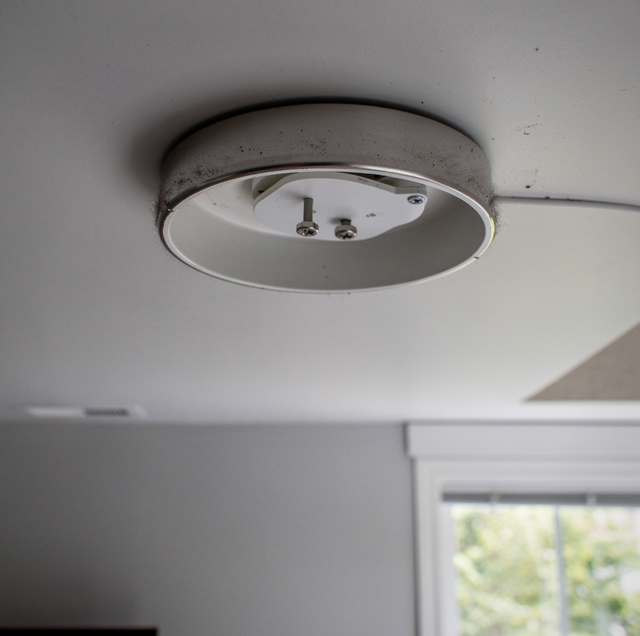
A ceiling that already holds a light fixture has power, a box, and a switch, which gives a fan three of the things it needs to run. Whether a fan can hang there depends on three things hidden above the light's canopy. The first is what the ceiling box is fastened to: a joist, a brace, or only the drywall around it. The second is whether that box was designed to carry a moving load or only to serve as a fixture that sits still. The third is what wiring runs down to the wall switch, since that decides how the fan and its light can be controlled. None of the three can be read from the room below, and each one changes the scope of the job.
Each thing that can turn up at the fixture location has a meaning for a fan and adds a share of work:
| Found at the Fixture Location | What It Means for a Fan | Work It Adds |
|---|---|---|
| A box made for fans, fastened to framing | The support is already in place | The fan mounts to the box once the connections are checked |
| A light-only box | The box was built for a still load and is not a fan support | A fan-rated box goes in, with a brace if the framing calls for one |
| A shallow pancake box screwed to a joist | The framing behind it is solid; fan use depends on how the box is rated | The box stays if it is rated for fans, or a fan-rated version replaces it |
| A box held by the drywall alone | Nothing structural carries the weight | A brace between the joists and a fan-rated box |
| One switched cable to the wall | One switch runs the fan and its light together | Pull chains or a remote split the two, or a new cable is run |
| Two switched conductors to the wall | Separate wall control for the fan and the light is possible | A two-control switch arrangement at the wall |
| A sloped or low ceiling | Standard mounting may not hang the fan plumb or clear | An angled mount, a low-profile fan or a different downrod |
Why a Spinning Fan Loads a Box Differently
A light fixture hangs still. Its weight pulls straight down on the box, and once the screws are set, that pull does not change from one hour to the next. A ceiling fan puts three different forces into the same box.
The first is its weight, which can exceed that of an ordinary fixture and hangs lower on a downrod, so any sideways motion works on a longer lever. The second is rotation. Blades that are a hair out of balance throw the motor slightly to one side on every turn, and the box feels that as a steady back-and-forth push for as long as the fan runs. The third is torque. When the motor starts, speeds up, or reverses, the housing tries to turn in the opposite direction from the blades, and the mounting bracket, the box, and its fasteners resist that twist.
A box sized for a still fixture has none of that in its design. Over a long running time, the cyclic push can loosen mounting screws, strip threads in a thin box, crack a plastic box, or slowly work a box nailed to its framing free. That failure builds with running time and ends with a heavy, spinning load that nothing solid can hold to the ceiling.
The Box and the Brace Between Joists
A fan-rated box is built and fastened to take all three of those forces. Its body and fan-mounting screws are designed to support a moving load, and it is fastened to the framing. When the old light box sits against a joist, a fan-rated box can take its place on that same joist. When the fixture sits between two joists, as a light centered in a room can, a brace spans the gap and bears on the framing at both ends, with the fan box hanging from its middle.
In older homes, a light box can hang from a bar that is too light for a fan, or from a strip of wood the original builder nailed in. Some boxes were set with no framing contact at all, held only by ears resting on the drywall or plaster. Each of those is swapped out because the fan's question is about the whole path from the blades to the joists, and a strong box on a weak mount fails at its weakest point.
The first step at the fixture, before anyone removes it or looks into the box, is to switch off the breaker that feeds it and confirm the light is dead. The cavity above can also carry cables from another circuit that stay energized after that breaker is off; that is one more reason the box work is left to an electrician.
A fan hung from a box built only for a light can work loose over time, and a falling motor and blade assembly can injure anyone beneath it. Box, brace, and switch-wiring changes are the electrician's responsibility.
One Switch or Two for the Fan and the Light
The cable between the ceiling box and the wall switch decides how much control the wall can offer. A standard light fixture needs a single switched conductor: the switch sends power up to the light, and that is all. A fan with a light kit has two things to control: the motor and the lamps.
If only one switched conductor reaches the ceiling, one wall switch turns the fan and its light on and off together. The pull chains on the fan, or a remote with a receiver, then separate the two once the power is on. For separate wall control for each, a second switched conductor must run between the switch box and the ceiling box. In a cable that carries three insulated conductors, the extra one serves that purpose, and a two-control switch or a pair of switches at the wall uses it. Where that extra conductor is missing, adding it means pulling a new cable through the wall and ceiling.
Where the supply arrives at the ceiling box first, and only a switch loop drops to the wall, the neutral stays in the ceiling, and that layout sets its own limits on which switches and controls fit at the wall.
Ceiling Height, Slope and Blade Clearance
A fan needs room on three sides of its blades: space below, so people and furniture clear the tips; space above, so the blades have air to draw from; and space beside, so the tips clear walls, beams and cabinets.
On a low ceiling, a low-profile fan mounts close to the box with no downrod, so the blades sit as high as the design allows. On a tall ceiling, a longer downrod brings the blades down to the level of the room, where the air they move can reach the people in it. The span of the blades is matched to the size of the room, so a fan in a large space and one in a small bedroom are chosen differently.
A sloped ceiling adds one more question. The fan must hang plumb, and a mount made for sloped ceilings lets the downrod pivot so the motor hangs straight down from an angled box. On a steep slope, the upper blade tips pass close to the ceiling, so a longer downrod is fitted to keep them clear. The box on a slope still has to be fan-rated and fastened to framing, because the slope does nothing to reduce the forces on it.
Remote and Wall Controls
The wiring above the ceiling sets which controls fit. Pull chains need no extra wiring, but they put the controls overhead, and a tall ceiling can leave them out of reach.
A remote works through a small receiver mounted inside the fan's canopy or motor housing. The receiver takes the switched power from the ceiling box and splits it between the motor speeds and the light, so separate control comes without a new cable to the wall. That suits a ceiling where only one switched conductor arrives, and some fans are sold with a remote and receiver and no pull chains at all. The receiver needs room in the canopy, which a crowded box can take away.
Wall controls come in more than one form. Two switched conductors allow two wall devices, one for the fan and one for the light. Some wall controls send their commands over the existing wiring to a receiver in the fan, which gives wall control over one switched conductor on the systems built for it. A wireless wall remote can also sit on a plate where the old switch was, provided the fan still gets steady power.
When the Job Grows Past a Fixture Swap
Some finds above the ceiling change the scope. Cloth-covered conductors at the old fixture indicate older wiring whose insulation can crack when handled, so the wiring is inspected before a new fan is connected to it. A plaster ceiling can crack around the opening when the old box is removed, so the opening is cut and patched with care. And a fan in a spot with no fixture at all means running power and a switch leg to a new location, a larger job than working where the light already hangs.
The signs that stop a fan's use are the same whether it is new or old. A fan that shakes loose at the canopy, sparks at the ceiling, or gives off a hot smell is switched off at the breaker and left off until an electrician has opened it up.
Frequently Asked Questions
A box designed to support a fan carries a marking, stamped or printed inside, stating that it is acceptable for fan support. It sits out of sight until the electrician has the breaker off and the fixture down. A box that shows no such marking is treated as a light-only box, however solid it feels.
No. A box can be marked for a fixture weight and still carry no fan rating, because a chandelier is a still load. A fan box is marked separately for fan support. Holding a heavy fixture shows that the box and its mount took the weight; rotation and torque are separate tests, and the fan marking covers them.
In the ordinary case, no. Retrofit fan braces are made to go in through the opening left by the old box. The bar slides between the joists and is turned until its ends bite into the framing on both sides, so no attic access is needed and the fan's canopy covers the same hole.
A fan with a light kit carries a separate lead for the light alongside the one for the motor, and on some fans that light lead is blue. When only one switched conductor reaches the ceiling, both leads join it so one switch powers both, and the fan's own controls divide them.
For fans that keep their chains, the chains are set once, the motor runs at its highest speed, and the light is on, so the receiver can control everything below those settings. If someone pulls a chain to off afterward, the remote can no longer turn that part back on until the chain is pulled again.
It can be. Older sprayed-on ceiling texture can contain asbestos, and fitting a new box or brace disturbs the texture around the opening. Testing a sample of the texture before that work starts shows how the ceiling has to be handled.
Commission ceiling fan installation with a fan-rated box upgrade where the old box falls short — fan-rated boxes and braces between the joists, switch wiring for separate fan and light control, and downrods matched to the ceiling. Safeline Electric serves Vancouver, Camas, Battle Ground, and the surrounding Clark County and Southwest Washington area. Call (360) 505-0663.