
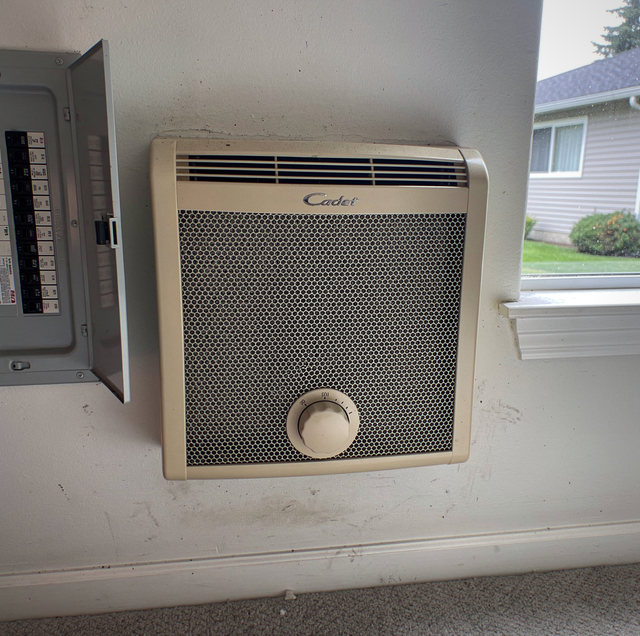
A Cadet wall heater has one job and four ways of not doing it, and the one you have decides what you do next. Your unit might click at the thermostat and sit there. It might run its fan while your room stays cold. It might warm your room and then quit on you. Or you might have a heater of your own that has gone completely dead.
Those four faults do not share a cause, and your symptom narrows them for you before anyone opens the unit. Two of them you can sort out yourself in ten minutes, with your hands nowhere near a wire. The other two sit behind a grille on a 240-volt circuit, so your half of the job stops there.
The Same Complaint Covers Four Very Different Failures
All four arrive as one phone call, and under the cover they have little in common. A Cadet wall unit is a resistance element with a small fan behind a grille, fed by a line-voltage circuit and switched by a thermostat built into the heater or mounted on the wall. Nothing about it modulates. The element is either being asked for heat, or it is idle, and your thermostat is the part doing the asking.
So the useful question for you is which of the four your heater is doing: no response at all, cool air out of a running fan, heat that arrives and leaves within seconds, or output that has faded across a couple of heating seasons. Each one points at a different part, and only two of those parts are ones you can safely go near.
Why Is the Fan Running While the Air Stays Cold?
A Cadet heater has five known causes for blowing cold air, and the split inside that list matters more than its length: only two of the five are yours to check. Your fan switch and your thermostat setting are the whole of that first one. A fan switch left on while the thermostat sits below the actual room temperature means the heater is doing exactly what it was told: moving air without ever calling for heat. The second is timing. The fan keeps turning for a stretch after the element stops, dispersing the last of the warm air and then plain room air behind it, so a hand held in front of the grille at the wrong moment feels a failure that is really a normal shutdown finishing itself.
Switch the heater's breaker off and confirm the unit is dead before any grille screw comes out, since these run at 240 volts, and leave the wiring and elements behind that grille to a licensed electrician.
Two more causes on that same list are a loose wire coming from the elements and an element that has failed outright, and they are named at this point so you can recognize them and stop. Both sit behind the grille, on the wiring side of a heater fed at 240 volts, and neither is a homeowner check with the power on, whatever a forum thread suggests about testing an element for continuity. What you can do before you call is worth doing: note whether the fan runs, whether the thermostat is calling, whether the breaker has moved, and how long your unit ran before the air turned cold. That is the sequence an electrician would have walked you through on the phone anyway. Four observations, none of them needing tools, will save the first ten minutes.
Nothing at All: What a Dead Heater Rules In and Out
When your thermostat goes up, and nothing happens, the circuit comes before the heater. A wall heater is usually on its own circuit, so the lamp and outlets in the same room working proves nothing about the heater's supply. Find the breaker for that heater and check whether it has moved out of position, since a breaker set halfway is easy to miss.
A breaker that resets and then holds means the trip was a one-off worth watching. A breaker that trips again as soon as your heater calls is the point to stop and hand it over, because something downstream is drawing current it should not. And if the breaker is on, the thermostat is calling, and your unit still does nothing at all, your own list is finished, and the fault is inside the wiring or the element.
Circuit Capacity Is the Element's Draw Against the Wire It Sits On
The underlying arithmetic runs to one line: amps equal watts divided by volts. A 2,000-watt heater on a 240-volt supply draws 8.33 amps, and it draws that steadily for as long as your thermostat keeps calling, which is what separates a heater from an appliance that wakes in short bursts. The circuit feeding it was built for a particular number of amps, and the distance between those two figures is your whole capacity question. At the other end of that comparison, a 120-volt heater wired to a 240-volt circuit tries to deliver four times its rated wattage and overheats.
None of that is a duty you have to memorize. It is the reason your electrician asks what else shares the circuit before quoting the work.
The contractor's half of a dead-heater call runs on the same arithmetic. The published process for this work covers preparing the wiring, confirming panel capacity, and verifying dedicated circuits where the load needs one, and that verification is exactly the step that gets skipped when a second heater lands on a circuit sized for one. Nothing in your walls gives you a sign of it until both units call at once on the first truly cold evening of the year.
A Heater That Cycles On and Off Every Few Seconds
Short cycling feels like a broken heater and usually is not one. For a unit switching on and off every fifteen seconds under a digital thermostat, the fix is a thermostat setting change, and on some controls that means moving the heating cycle from the standard setting to the fan setting. The fix is a control setting rather than a part, and you can set it up in a minute.
The second case is different. When your thermostat is set correctly, and the heater still cycles in under five minutes, the wattage is too high for the size of the room. A Cadet heater is sized at 1,500 watts for a 250-square-foot room with central heat and 2,000 without.
A Discolored Grille, Soot on the Wall and Weak Output
A grille that has browned or darkened is due to dirt and lint buildup in the heating element rather than a fault in the paint. Extra heat concentrates wherever the build-up sits, and the discoloration follows it. A cleaning at least every six months is called for on that basis, and that one is your job.
Black marks on the wall around the heater are a separate matter, and the manufacturer makes it clear that the heater is not causing them. Candles, cooking, cleaning supplies, manufactured fireplace logs, pets, and houseplants release airborne particles, and the heater draws them in, where they partially burn into a carbon residue that sticks to walls.
When Replacing the Unit Becomes the Honest Answer
A Cadet wall heater has a working life of eight to twelve years, against more than twenty for a baseboard unit, so a heater whose output has faded gradually may simply be old, and your options change then.
A repair stops being the better answer at that point. Replacement and upgrades fall within the same published scope as installation, and swapping a tired unit for a current model with better controls is planned work with a known end. If your heater is at the far end of that range and its output has been sliding for two winters running, the replacement conversation is the honest one for you to have.
What an Electrician Checks After Your Own List Runs Out
Uneven heat and reduced airflow are service signs, and the electrician's version of this call starts where yours ended: confirming the supply voltage against the heater's rating, then checking the wiring and the mounting behind the grille. Anyone uncomfortable with electrical wiring should have a licensed electrician take the voltage measurement, since the panel must remain live while it is taken.
By then the question is no longer why a Cadet heater stops working. It is which half your failure sits in, and you now know which half you are holding.
Frequently Asked Questions
Your wall heater runs on a line voltage thermostat, the normal control for a single-room heater. Low voltage thermostats are built for central heating and cooling, and one is allowed on your heater only when your load exceeds the line voltage thermostat's rating, and you add a relay with it.
Your new heater often smells on its first run, a normal manufacturing residue burning off, and it clears after several hours. Your unit does the same with settled dust after an idle summer. What should worry you is a sharp or electrical smell, or one that keeps returning, and that is when your heater is worth a look from an electrician.
No. Cadet heaters carry a powder coat paint system that is electrostatically applied and baked onto the surface, and the unit is listed by UL as manufactured and should not be altered in any manner. Cleaning out the build-up that caused the discoloration is your route back, and a grille you have marked badly is a parts question for your electrician.
They warm your room differently. A wall heater uses a fan to distribute heat quickly, so a cold bedroom warms up fast. A baseboard unit generally needs thirty to sixty minutes to heat that room, but it runs at lower surface temperatures, which many households prefer where children sleep. If your complaint is a slow bedroom, your heater type is part of your answer.
Some Cadet heaters are dual rated, which means your unit can be wired to either of two voltages on your product label, and the wattage it delivers falls with the lower one. Take a 1,500-watt fan heater as an example: on 240 volts it draws its full rating, and on 208 volts it draws 1,125 watts, three-quarters of that. Your heater is not faulty in the second building, and you would be replacing a unit working to specification.
No, and what your reset is doing is the useful part. A Cadet heater cuts itself off at abnormal temperatures, and a tripped manual reset is a sign that the heater probably needs cleaning or is blocked. A dead unit is a different diagnosis entirely. Check that the supply voltage matches your rating and clear anything that blocks it. A reset that keeps tripping after your heater is clean and clear is a fire question, not a comfort complaint. If it will not reset and the circuit is good, the heater will need to be repaired or replaced.
A Cadet heater that stays cold after the thermostat and the breaker both check out has moved past the homeowner half of the list — a licensed electrician can trace the circuit, test the element and the wiring behind the grille, and replace a unit that is plainly past saving. Safeline Electric serves Vancouver, Camas, Battle Ground, and the surrounding Clark County and Southwest Washington area. Call (360) 505-0663.