
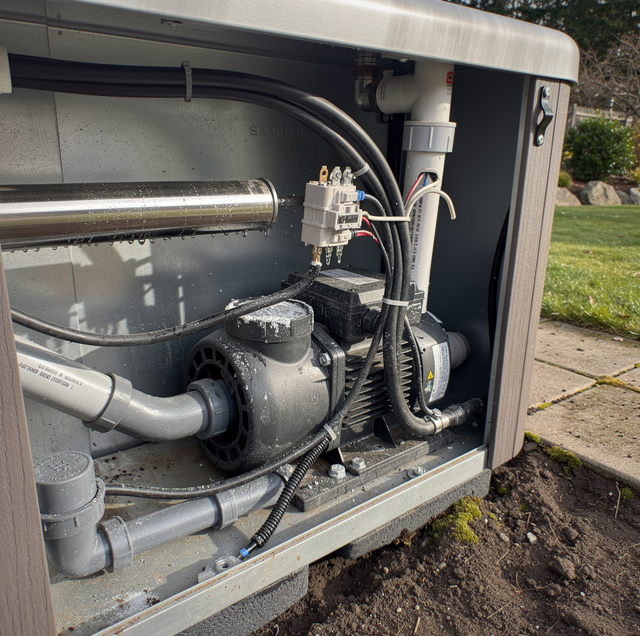
The ground-fault device on a hot tub circuit exists for one situation: a person sitting in heated, conductive water a few feet from a resistance heater and two or three motors, touching wet metal with bare skin. When that device shuts the tub down, it reports that some of the current that left the panel never returned on the conductor it should have. Something gave it a shortcut. The instinct to call the trip a nuisance and reset until it holds gets the problem backward, because the trip is the healthy part of the story. The leak is the part that needs attention, and it does not go away once the water is warm again.
Quick Answer: A spa GFCI trips because current is leaking out of the circuit, most often through a cracked heater element sheath, a water-soaked pump motor, or moisture inside the equipment pack. The tub stays off until that leak is found.
What a GFCI Measures and Why a Spa Disconnect Carries One
A ground-fault device compares the current flowing out to the tub with the current returning. In a healthy circuit, those two numbers match. Personnel-protection devices are built to act on an imbalance of roughly 5 milliamps, a level far below anything a breaker would notice as load and well inside the range that matters to a human heart.
The device pays no attention to how much power the tub draws. A circuit loafing along at a fraction of its rating still opens the instant a few thousandths of an amp go missing. Ordinary overload tripping, where the total load on a circuit exceeds what the breaker allows, is a separate failure with separate causes, and a spa ground-fault trip usually occurs at loads the circuit can easily carry.
Outdoor spas are fed through a disconnecting means placed within sight of the tub, and ground-fault protection on that circuit is standard practice for a spa installation. A GFCI receptacle in a bathroom or garage provides the same protection in a different package, covering a different kind of load, while the spa version protects one large, dedicated circuit that feeds a heater, motors, and a control board at the same time. Any one of those can be the leak, which is why a spa trip has to be traced rather than guessed at.
One reset tells you whether the trip was a single event. If the device drops again, the tub stays off, and the circuit needs a technician; repeated resetting wears the device and re-energizes a real fault between attempts.
Where Water Gets into the Equipment Pack
Take the side panel off a tripping tub, and you are looking at the part nobody looks at. Heater, circulation and jet pumps, blower, control board and their wiring sit packed into a cabinet a few inches off the ground under the shell.
Water reaches it more ways than most owners expect. A cabinet panel that has warped or lost its seal lets driven rain run down the inside face and drip onto the pack. A cover that no longer seats at one corner, or gets lifted by a gust, sends spray into the shell perimeter and down into the equipment bay. Condensation forms wherever hot plumbing meets cold cabinet air, and it collects on the coldest available surface, often a metal housing or a terminal block. Irrigation is the quiet offender: a head aimed at a shrub two seasons ago now sprays the cabinet wall every morning on a timer, soaking one side of the pack. Rodents make it worse, because that cabinet is the warmest dry space in the yard, and a nest built against the wiring comes with chewed insulation.
None of this requires standing water. Spa water carries dissolved minerals and sanitizer, and a thin damp film across a terminal, a connector body, or a nicked conductor conducts well enough to carry a few milliamps into the grounded metal beside it. Current leaves, fails to return, and the device opens.
Moisture faults tend to have a rhythm. A trip that begins after a windstorm, or that clears during a dry stretch and returns with rain, points at water intrusion before a single component has been tested.
The Heater Element and the Cracked Sheath Problem
A spa heater is a resistance coil sealed inside a metal tube, with the space between coil and tube filled with compacted magnesium oxide powder. The powder holds the coil in place, conducts heat outward, and electrically insulates the coil. That thin sheath is the only barrier between an energized element and the water flowing across it.
Sheaths fail from the outside in. Scale builds on the surface, corrosion pits it, debris scores it, and eventually there is a hairline opening. Magnesium oxide pulls in moisture readily, so water wicks into the powder and stays there, and wet magnesium oxide conducts. Current now runs from the coil, through the damp powder, through the sheath, and into the spa water, where it finds the bonded metal fittings and the earth. It never returns on the conductor that carried it out, and the device does exactly what it was installed to do.
What fools people is that everything else still works. Pumps run, jets come on, the topside display lights up. The element leaks only when energized, so the tub behaves normally until the controller calls for heat. Owners describe finding the water cold, resetting once, watching the tub come back, and losing it again twenty minutes later. That delay is the fingerprint of a heater fault, and a cracked element is the single most common reason a spa GFCI will not stay in.
Never bypass, jumper, or swap a tripping spa GFCI for a standard breaker. That device is the only thing standing between a leaking heater and a person in the water. A breaker that keeps tripping means the tub stays off.
How a Failing Pump or Blower Motor Leaks Current
A drip under the pump points at the shaft seal, the wear part between the two machines bolted together inside every spa pump, a wet end that moves water and a dry end that spins it. When it goes, water follows the shaft into the motor housing, wets the windings, and works into the varnish insulating them. Soaked insulation reduces resistance, and a winding with degraded insulation allows current to flow into the motor frame, which is grounded and bonded by design.
A motor in that condition often keeps running, which is why the tub still seems fine between trips. The leak surfaces under specific conditions: at start-up, when inrush current is highest, and the weakest spot in the insulation is stressed hardest, or after the motor has warmed, and its insulation resistance has fallen. If the trip lands within a second of a filtration cycle starting, or the moment the jets switch to high, that timing is worth reporting.
Blowers fail differently. A blower pushes air into the footwell and sits above the waterline so water cannot travel back up the line. When a check valve fails or a line sags, water reaches the blower housing anyway, and from there a motor never built to get wet. Blowers run far less often than pumps, so the fault can go undetected for months and then trip the circuit the first evening someone turns the bubbles on.
Bonding and Grounding at a Spa Do Different Jobs
These two words get used interchangeably around spas, and they describe separate systems.
The equipment grounding conductor runs with the circuit from the panel to the spa, and its job is to give fault current a low-resistance path home. That path is what lets protective devices operate: current reaching grounded metal has somewhere to go, and that current is exactly what the ground-fault device registers as missing.
Bonding is local. A bonding conductor ties together the metal a bather can touch or stand near, including pump and heater housings, metal fittings in the shell, rails, and reinforcing steel in a concrete pad. Bonding does not clear a fault and does not carry current under normal operation. It holds every piece of metal in the area at the same electrical potential, so there is no voltage difference for a body to complete.
A weak bond rarely causes tripping by itself; it strips away the second layer of protection while a leak exists in the pack, and outdoor bonding connections sit in wet soil where corrosion works on them for years. A tingle at a kitchen faucet or a laundry appliance points to something else in the house wiring entirely, while at a spa the bonding system exists so that a leak inside the equipment pack never gets the chance to be felt on the shell.
Isolating the Circuit Before Anything Gets Replaced
The fastest way to spend money on a spa without fixing it is to order the part that usually fails. Heaters get replaced first, and a fair number of those tubs trip again on the new element, because the water that killed the first one is still in the cabinet or because a wet pack corroded more than one thing at once.
Diagnosis on a spa circuit has one goal: name the leaking component, with evidence, before anything is bought. A technician confirms the fault is real and repeatable, then evaluates the circuit and each load in the pack independently with power secured throughout, working out which one loses insulation and under what conditions. Wiring between the disconnect and the pack gets evaluated the same way, because a chewed conductor and a failing heater look identical from the breaker.
The homeowner supplies the other half of that evidence, and it is the half nobody can recover later.
What to Note Before the Appointment
- Whether the breaker trips the instant it is reset or holds for a while and then drops
- Whether the trip lines up with the heater running, a filtration cycle, or the jets switching on
- Whether the trouble began after heavy rain, a windstorm, a freeze, or a change to the irrigation schedule
- Whether the water is cold when the trip is discovered, which points toward the heating side
- Whether the trips cluster around the same time of day
Whether a panel has room for a spa is a sizing question answered before the tub is installed, and a circuit that has carried this tub for years has not suddenly run short of capacity on the day its device started dropping. What changed is insulation somewhere on that circuit. A finished repair ends the same way: the failed component is replaced, the water intrusion is closed off, and the device is verified to hold through a full heat and filtration cycle.
Frequently Asked Questions
Yes, and it happens often. Spa controllers run freeze-protection and filtration cycles on their own, energizing the circulation pump and frequently the heater when water temperature drifts toward a threshold. A tub untouched all week can drop the circuit at three in the morning because the controller called for heat.
It can. A spa ground-fault breaker contains sensing electronics and a mechanical trip assembly, both of which age. Surges from utility switching degrade the sensing circuit, and an outdoor enclosure exposes it to temperature swings and humidity indoor breakers never see. An oversensitive device gets replaced during the repair, but it is diagnosed as a possible cause, never assumed to be one.
Indirectly, and often. Scale from hard water insulates the heater sheath, letting it run hotter than designed and stressing the metal. Sanitizer held too high, or soft water with low calcium hardness, pits stainless steel from the water side. Both shorten element life and attack pump seals.
It belongs on the list. Spa lights sit in a niche behind a gasketed lens, and that gasket is the only thing keeping water off the lamp assembly and its cord. Gaskets flatten and harden with age. Modern spa lighting runs at low voltage, but the supply side of that light transformer does not, and its wiring shares the same wet cabinet.
Yes. A spa is wired on a dedicated circuit sized per the equipment data plate on the pack, which lists the current the tub draws with the heater and pumps running. Sharing that circuit with path lighting or an outbuilding puts unrelated loads under the same protective device, and small leakage currents from several sources sum until the total crosses the trip threshold.
Usually, though, the water needs attention. With the circuit off, nothing circulates or filters, so sanitizer demand climbs, and biofilm begins forming in the plumbing within days. In freezing conditions, the freeze-protection cycle is unavailable with power off, and standing water in the pipes can split a fitting. Draining is the technician's call.
Book a hot tub circuit diagnosis — a licensed electrician traces the leakage to the component causing it and repairs the spa circuit properly. Safeline Electric serves Vancouver, Camas, Battle Ground, and the surrounding Clark County and Southwest Washington area. Call (360) 505-0663.
