
Standby Generator Won’t Start During an Outage, and What It Tried
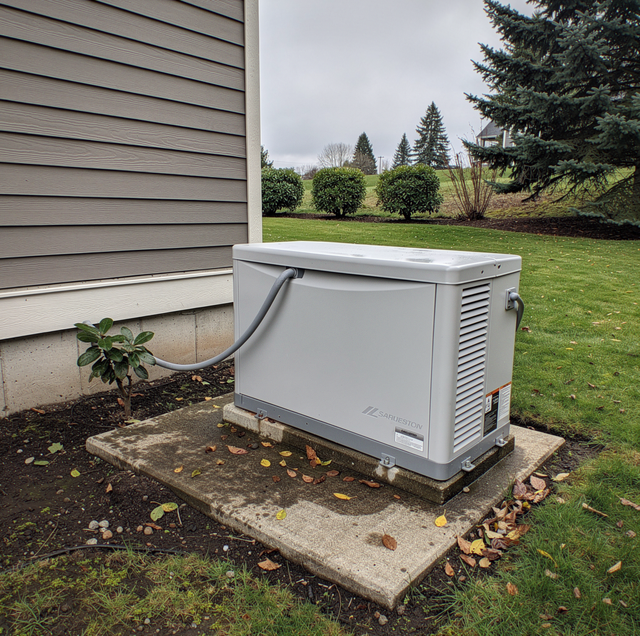
The power has been out for half an hour, and the unit on the pad beside the house has not made a sound. Nothing has moved on it since the line went down. A standby set is the one appliance in a house with a job to do during an outage, so a quiet one has already failed at that job at some specific step, and it has kept a record of which step.
Which step it was carries more weight than it sounds. A unit that never tried at all and a unit that tried and could not finish are pointing at different parts of the machine, and you can hear the difference from the driveway.
Listening at the Enclosure Before Anyone Arrives
The first thing to establish is whether the engine is running, because a set that runs while your house stays dark has no starting fault. A normal start settles into a steady note within a minute, and if you hear that note with the lights still out, the problem sits on the connection side and needs a different visit.
A standby set left in AUTO can crank and start at any time without warning, so anyone working on or around the unit should set the controller to OFF and disconnect the negative battery cable before touching anything else.
With that ruled out, silence is the first real class. Either the controller never called for a start, or it called, and nothing answered, and either way the starter never turned the engine. From the driveway, the machine looks exactly as it did the day before.
The second class is loud and short. The starter engages, the engine turns in bursts with pauses between, and after a minute the turning stops for good. Everything ahead of combustion worked, the battery had enough in it to spin the engine, and the engine never caught.
The third class runs. The engine catches, holds a steady note, then quits on its own after seconds or minutes, sometimes over and over. A set that got that far has proved it can crank, take fuel, and make spark, which moves the question downstream.
Why Is the Unit Silent While the House Is Dark?
Only one of the controller's modes starts the engine with nobody present. In AUTO, it watches the incoming utility voltage and cranks on its own when that voltage drops far enough for long enough. MANUAL cranks the engine when a person presses the button, and it will not hand your house over unless the utility has actually failed. OFF shuts the engine down and blocks automatic operation. A unit left in MANUAL or OFF after someone worked on it sits out the whole outage doing what the switch told it to.
The dropout it waits for is a fraction of normal voltage rather than a total loss. That threshold is set at 65 percent of nominal, about 156 volts on a 240-volt service, fixed on one controller family and adjustable on the other. The controller still sees a live utility when a sag stays above that line, so the engine is never asked to start with your lights out. A small fuse produces the same silence: air-cooled units carry a 7.5-amp fuse protecting the controller and its DC circuits, and with it melted open, cranking is not possible except on the newer controller family running updated firmware.
What Happens When the Engine Turns Over but Never Fires?
The cranking pattern is written into your controller. That pattern runs as a 16-second crank, a seven-second rest, a second 16-second crank and rest, then three more cycles of seven seconds cranking against seven resting. Five attempts, 53 seconds of cranking, about a minute and a half end-to-end, then the controller stops and displays "Overcrank" on its screen.
A failed attempt is narrower than an engine that did not run. The controller looks for a running speed within a set window after the starter releases, and sets that speed to 2,200 rpm within 15 seconds. An engine that fires, stumbles, and sinks back under that speed has failed as completely as one that never fired, which is why a unit you heard catch still shows Overcrank.
Overcrank narrows your search to fuel and ignition, since the cranking half of the job visibly worked. The first check is the fuel shutoff valve. A battery flat enough to spin your engine slowly, and a fuel line that cannot deliver the volume a running engine draws, land in the same place. The alarm stops the machine grinding its starter against a fault repetition that was never going to clear.
The Set That Starts and Then Quits
A set that holds a steady note has proved everything a start depends on, from the battery through the ignition, inside about ten seconds. The question shifts from starting to what your machine is asked to do next, and whether it can keep its output steady while doing so.
Engine speed and output frequency are the same measurement here, so a set that bogs under the load it just picked up in your house shows the strain as a falling frequency. That load arrives in one step, and the engine has to find the extra fuel inside that step. The shutdown point for a 60-hertz unit is set at 55 hertz held for more than 30 seconds. Messages in that family read "Underspeed" and "Overload Remove Load," each describing an engine that started cleanly and then met more than it could carry.
That makes it a different first question for whoever arrives. Nobody troubleshooting a set that ran four minutes starts at the battery, because the engine settled the battery question itself. What you noticed fills the gap: how long it ran, and what was switched on at the moment it stopped.
Cold, Corrosion, and a Crank That Sounds Slow
A starting battery sits untouched for months and then has to deliver everything it has in one stretch, and both cold and corrosion cut into what it can deliver. Long damp seasons push moisture into the enclosure and onto the terminals around the battery, and a white or green crust on a post is resistance sitting in series with the starter. Cold thickens the oil the same starter turns against. The audible result is a crank slower and heavier than the one you know, and slow cranking fails the controller's speed window even when the engine itself is sound.
That gives you something worth listening for. An engine that spins fast and evenly through all five attempts and never catches is a different report from one that groans, slows, and gives up inside the first fifteen seconds, and the second of those narrows the search to the parts that lose capacity in the cold. A set that starts fine on a mild afternoon and refuses on the first cold night does the same thing more slowly. Neither belongs to you to fix at the enclosure, but both change where a technician starts.
Reading the Fault Display Before Anyone Clears It
A technician's first move at a stopped unit is to read the message on your controller's screen and write it down before touching the mode switch, because the machine retains only one copy. The checks that follow, and their order, depend on which message is showing.
When a monitored value leaves its band, the controller latches the fault. It shuts down the engine and keeps the message on the screen. Each alarm carries a lockout type alongside its hold-off and duration times, and the types are not uniform: some faults re-crank a fixed number of times first; others go to a hard lockout with no retries. A latched fault stays latched, so your unit sits out the next outage too.
Unlatching it takes seconds. The procedure is to set the controller to OFF and press Enter, which releases the active fault and wipes the message. Once that is done, a unit that has been sitting on a fault for six weeks looks identical to one that has never had a problem, and the next person to open the door starts from an empty screen.
Frequently Asked Questions
Not instantly, and the pause is deliberate. The controller waits out a line-interrupt timer first so a momentary blink at your house does not start the engine. That timer runs five seconds on one controller family and a ten-second factory default on another, with a range an installer can widen further. A warm-up timer then runs before your house is switched over. If yours has been quiet under a minute, it may still be counting.
Green means the unit is in AUTO and ready; red means an alarm is active and the machine has stopped. Green with a dark house is the state to expect while a start delay is still counting down. One state catches owners of a new unit: if it was never activated after installation, it runs only in manual, and the screen says so, which is easy to mistake for a dead machine on the night you need it.
That risk is why the crank limit exists. The controller stops after its programmed cycles rather than turning until the battery dies, which protects the starter as much as the battery. On 8-kilowatt air-cooled units, a second overcrank alarm is written for exactly this, triggered after ten unsuccessful crank attempts to cap the cycles the starter sees. Your unit may not carry that alarm, but all of them stop on their own.
No, and it surprises people watching it happen. During an automatic crank attempt, the cycle does not abort when the utility returns; it runs to completion, and if the engine starts, it runs for 1 minute before shutting down. A set that fires up after your lights are already back is behaving normally, and that brief run is not proof it would have started earlier.
Your generator carries a main line circuit breaker of its own, separate from anything in your house, and the setup procedure for automatic operation calls for it to be closed. An engine will start, run, and hold speed perfectly with that breaker open, and no output leaves the machine. From inside your house, that is indistinguishable from a failure to start, which is one more reason the first look happens at the unit.
Because engine protection stopped it. Low Oil Pressure and High Engine Temp sit on the controller's alarm list alongside Overcrank, and both stop an engine that was running well. The controller holds off watching oil pressure for a few seconds after a start, so the shutdown lands after the engine is up rather than during cranking. The high-temperature switch closes near 293 degrees Fahrenheit and lets your unit restart once it has cooled.
A no-start that has already been cleared leaves a technician nothing to read — the unit's own scheduled exercise run is the next time it cranks unprompted, so booking the visit against that run puts someone in front of the machine while it is trying to start. Safeline Electric serves Vancouver, Camas, Battle Ground, and the surrounding Clark County and Southwest Washington area. Call (360) 505-0663.
