
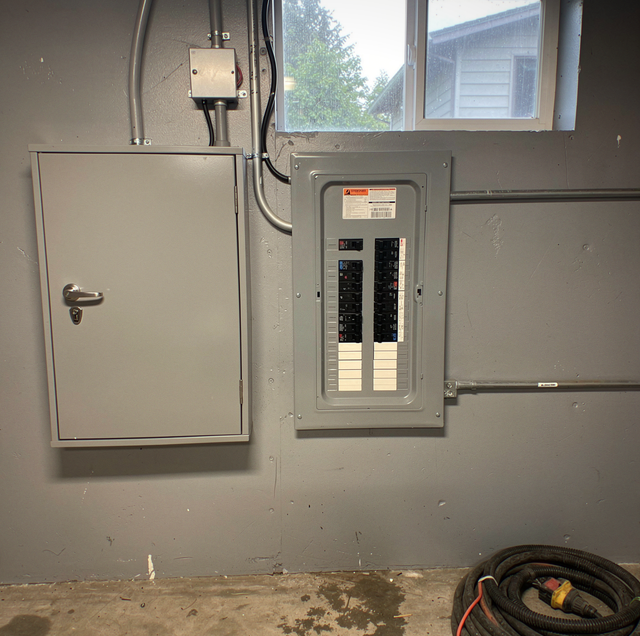
The lights go out a little after dinner and stay out. You wheel the generator out of the garage, it starts on the second pull, and within a minute you are standing in the driveway holding a cord with nowhere useful to put it. The furnace blower, the well pump, and the kitchen circuits are wired into the panel, and the generator has no way into that panel except the one you give it.
A transfer switch is the equipment that gives it a safe one. It connects your circuits to one source at a time, the utility or the generator, with no position that joins the two, so generator power reaches the house without escaping back onto the lines that serve the street. Manual or automatic, whole house or a few circuits, the rest is detail.
Backfeed and the People It Puts at Risk
Backfeed is generator power traveling the wrong way. Your panel connects to the utility via the service drop or an underground lateral, which runs to a transformer that also serves several neighboring houses. A transformer works in both directions. It steps the utility's distribution voltage, thousands of volts, down to the 240 volts your panel uses, and when 240 volts arrives on its low side from a generator, it steps that up to distribution voltage on the high side.
That turns a line the utility has switched off into a line carrying lethal voltage from a house no one on the crew has seen, and the person in danger is the worker restoring your service, handling a conductor that was supposed to be dead. The same backfeed energizes the service wires of the other houses on that transformer, so anyone working on a neighbor's system can meet voltage where there should be none.
The hazard also runs toward your own equipment. When utility power returns while a generator is still tied to the house wiring, two sources meet on the same conductors out of step with each other. The generator, the wiring between it and the panel, and whatever is plugged in can take the damage, and a fire can follow.
How a Transfer Switch Keeps the House on One Source
Inside, a transfer switch is a double-throw switch. The circuits it serves connect to a set of contacts that close against the utility side or against the generator side, and the mechanism has no position with both closed. Moving from one source to the other opens the first connection before the second one closes. That break-before-make action is the whole safety case: while the generator feeds your circuits, the path back to the service drop is open.
Where the switch is located determines how much of the house it covers. A whole-house switch is installed at the service entrance, between the meter and the panel, and controls everything downstream of it. A load-side switch mounts beside the existing panel and takes over a chosen group of branch circuits, leaving the rest dark. Either way, the generator reaches the house through a dedicated connection point, an inlet box on an outside wall for a portable or a permanent feed from a standby unit.
| Manual transfer switch | Automatic transfer switch | Interlock kit | |
|---|---|---|---|
| How it isolates | Double-throw handles, per circuit or for the whole service | Double-throw contacts; the switch moves on its own | A plate that keeps the main and the generator breaker from both being on |
| Who acts in an outage? | You, at the switch | The switch and a standby generator | You, at the panel |
| Circuits it can carry | The ones wired into it | A chosen group or the whole house | Any circuit in the panel, picked at the breakers |
| Where it mounts | Beside the panel or at the service entrance | Between the meter and the panel, or beside the panel | On the existing panel's front cover |
Manual or Automatic Transfer
A manual transfer switch relies on you. With the generator running and plugged into the inlet, you move the switch to generator, and back to line when the utility returns. A load-side manual switch has a handle for each circuit, so you can bring the furnace on, give it a moment, then add the refrigerator, and motors start one at a time.
An automatic transfer switch pairs with a standby generator and needs nobody awake or home. It waits for the generator's output to settle before moving the load across, and when the utility returns, it waits again until that supply stays steady before moving the load home.
Which suits you turns partly on how your power fails. Where wind and ice storms bring the lines down, the outage arrives in the middle of bad weather, and a manual switch sends someone out into it to start the generator, connect the cord and throw the handles at whatever hour the lines fell. Automatic transfer takes that trip outside off the list. Where outages are rare, the trip outside comes up seldom, and a manual switch you operate once in a while asks little of you.
What an Interlock Kit Does Differently
An interlock kit reaches the same result without a separate switch. It is a metal plate or slide mounted on the panel's front cover, between the main breaker and a breaker reserved for the generator. In one position, the main can be on, and the generator breaker is held off; slide it across and the generator breaker can close only once the main is off. The generator feeds that breaker from an outside inlet box, and the panel's bus carries its power to whatever circuits you leave on.
Against a transfer switch, the differences are practical:
- Scope: Every circuit in the panel is available, and you pick at the breakers which ones stay on.
- Load control: The plate blocks only the state where both sources are on. It does nothing to stop you switching on a load the generator cannot carry, so the choosing falls to you each time.
- Operation: An interlock is manual by nature, with no version that starts a generator or transfers on its own.
- Hardware: It works inside the panel you already have, with no second enclosure and no prewired set of circuits.
- Utility return: With the main off, the house gives no sign when the grid comes back unless a utility-return light was fitted at the panel, so without one, switching back over is a check you make yourself.
Why a Cord in an Outlet Is Not a Connection
Running appliances straight from the generator is a legitimate use. A refrigerator or a lamp plugged into the generator's own receptacles with outdoor-rated extension cords stays outside the house wiring, so no transfer equipment is involved. What those cords cannot reach is anything hardwired: the furnace, the well pump, the water heater, the ceiling lights. That gap is what tempts people to push power into the house through a wall outlet or a dryer receptacle using a cord with a plug on both ends.
A receptacle is built to deliver power to a plug, not to accept it, and its branch wiring was sized to supply one circuit, not to feed a panel. The only thing standing between that arrangement and the utility lines is a person remembering to open the main breaker first and leave it open for as long as the generator runs. With the main on, generator output leaves through the service drop, and a returning utility meets the generator on the same wires. Transfer equipment replaces that memory with a mechanism that cannot be skipped.
Switching the main off before feeding a wall outlet from a generator protects nobody; once someone flips it back on to check for power, generator voltage is sent onto lines crews are repairing. Leave that connection to an electrician's transfer switch.
Sizing the Switch to the Service and the Circuits
Transfer equipment is sized on the current it carries and the circuits it reaches. A whole-house switch at the service entrance carries the full service, so a 200-amp service requires a switch rated for 200 amps. Because it becomes the home's main disconnect, it is a service-entrance-rated model. A load-side switch carries only the generator's feed and offers a fixed number of circuit positions, and the circuits you give it are the ones you want through a long outage. Anything left off stays dark.
The generator sets the ceiling either way. A switch rated above the generator's output adds no capacity, and the feed from the inlet to the switch or generator breaker is sized to the generator. The circuits you select have to fit within that output, allowing for the brief surge a motor draws as it starts. An electrician works through those numbers against your actual loads before choosing the switch, and on an older panel, the check can reveal work needed first, such as failing breakers.
Permits, Placement, and the Installation Itself
Adding transfer equipment changes how power enters the house, and the local building department issues any required permits and inspections before the equipment goes into service; some utilities also ask to be notified when a home has a generator that can connect to its wiring. A label at the panel or the meter tells anyone who works on the house later that a second source is present.
Where the inlet goes determines where the generator sits, since the cord only reaches so far. An inlet beside the garage door or a bedroom window invites parking the generator there, where exhaust can drift inside.
A generator running in a garage, carport or beside an open window can fill the house with odorless carbon monoxide. Run it outdoors, clear of openings, and have the electrician mount the inlet where the cord reaches.
A standby installation adds the feeder and the control wiring between the generator and the automatic switch. The job closes with the system run on generator power and each transferred circuit confirmed.
Frequently Asked Questions
No, and backfeed is only part of it. With one end in a running generator, the bare prongs on the free end carry full generator voltage before they go into the wall and again the moment someone pulls them out. An inlet box avoids this by design: its male prongs sit recessed in a housing, and the cord that feeds it has a female connector on that end.
The switch transfers the neutral conductor along with the hot ones. Some portable generators bond their neutral to the frame for standalone use, and the house panel already bonds neutral to ground at the service. Connect that kind of generator through equipment that leaves the neutral shared, and you create a second bond, which splits neutral current onto the grounding path. One sign of it is the generator's own GFCI outlets tripping as soon as house loads come on. A switched-neutral transfer switch, or a generator set up with a floating neutral, keeps a single bond.
Match the inlet to the generator's largest receptacle. A 30-amp, 240-volt twist-lock inlet can handle up to 7,200 watts and pairs with generators whose largest outlet is a 30-amp twist-lock. Generators with a 50-amp outlet pair with a 50-amp inlet, good for 12,000 watts. The cord between them carries the same rating on both ends.
A 240-volt circuit takes two of the switch's positions, joined by a handle tie so both poles transfer together. That matters when you count circuits: a six-position switch holding two 240-volt loads has two positions left for everything else. The remaining 120-volt circuits are split between the generator's two hot legs so neither leg carries the whole load, since each leg can supply only half the generator's rated output.
Partly. A standby-style automatic switch calls for starting by closing a pair of control contacts in a two-wire start circuit, so the generator needs an electric starter and a controller that responds to that signal; some portables offer it. Other switches built for portables transfer on their own once they sense a running generator, but someone still has to start it by hand.
Not a standard home switch. Closed-transition switches overlap the two sources for an instant, keeping the load up, and they are used in commercial and critical facilities, where the generator is synchronized to the grid, and the utility approves the arrangement.
Book a transfer switch installation — an electrician sizes it to your generator, your panel, and the circuits you want kept on. Safeline Electric serves Vancouver, Camas, Battle Ground, and the surrounding Clark County and Southwest Washington area. Call (360) 505-0663.