
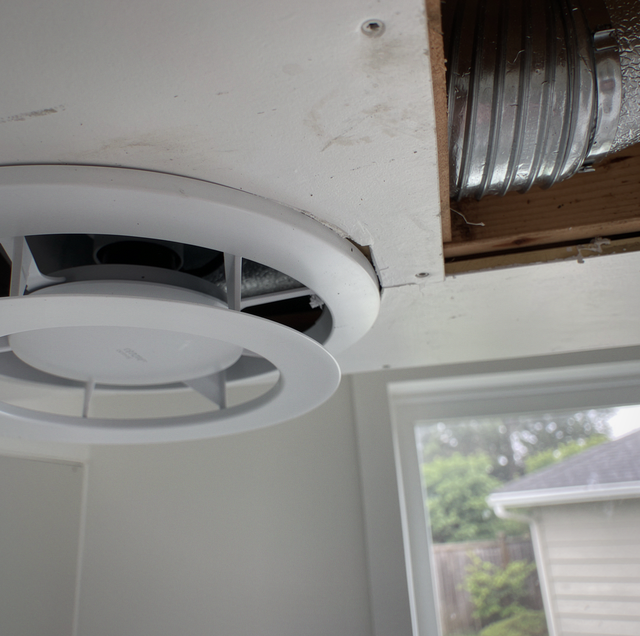
A bathroom exhaust fan pulls moist air out of the room and pushes it through a duct to the outside of the building, before the water vapor in that air can settle on a cold surface and turn back into liquid. A hot shower loads the room with vapor, and a mirror, an exterior wall, or a ceiling under an unheated attic is cold enough to collect it. So whether a bathroom needs a fan depends on how much steam the room produces and where that damp air ends up, and a window settles only part of that question. The fan is one piece of a system, and each piece, listed here from the ceiling outward with its job and its failure, has to be built right for the others to work:
| Part of the System | What It Does | What Goes Wrong When It Is Wrong |
|---|---|---|
| Fan housing and its placement | Draws steam into the duct from over or beside the shower | Set across the room, it clears drier air while the steam spreads over the ceiling |
| Duct run | Carries the damp air from the housing to the outside | Crushed, kinked, or sagging, it chokes the airflow and holds water in its low spots |
| Exterior termination | Releases the air outside the building shell | Left open in the attic or stopped short of a cap, it leaves the vapor on framing and insulation |
| Backdraft damper | Opens while the fan runs and closes when it stops | Jammed open or missing, it lets outside air travel back down the duct |
| Wiring and control | Powers the motor and decides how long it runs | A poor control choice shuts the fan off while the room is still wet, and a failing motor can overheat |
When a Bathroom Needs a Fan
The deciding question is whether the room makes steam. A hot shower or bath puts water vapor into the air each time it runs, and that vapor has to leave the room somehow. A half bath with a toilet and a sink produces very little moisture, so a fan there works on odor more than on water.
A window can do part of the job, but only when it is open, and only as fast as outside air carries the damp air away. A window left shut in cold or wet weather moves no air at all, and even an open window has no motor pushing the damp air out, so on those days the vapor stays in. An interior bathroom with no outside wall has no window to open, leaving the fan and its duct as the only route for moisture to exit the building.
Whether a particular bathroom requires a fan is a decision for the local building department and its inspector. On function alone, a room where the mirror fogs and the walls bead with water after a shower needs a way to push that air outside.
Sizing and Placing the Fan in the Room
A fan is rated by the volume of air it moves, and the size that suits a bathroom follows the room's size and use. A larger floor area, a vaulted ceiling, or both a tub and a separate shower call for more air than a small bath with one stall. The rating on the box is measured against a set amount of resistance, and the air the fan delivers in a house depends on the duct it pushes into. A long run with several bends delivers less air than the same fan on a short, straight one, so the fan and the duct route get sized together.
Placement decides where the fan draws from. Steam rises from the shower and spreads across the ceiling, so a housing set over the shower or close beside it catches the vapor before it spreads. A housing placed near the doorway draws from the part of the room the steam reaches last, while the ceiling above the tub stays damp.
The housing mounts to the ceiling framing, so it stays still when the motor runs, and the gap between the housing and the drywall is sealed. An unsealed gap lets warm, damp air slip around the housing and into the ceiling cavity above, which puts moisture right where the fan was meant to keep it out.
Building the Duct Route to the Outside
A bathroom fan has to end outside. Venting into an attic or crawlspace leaves moisture on the framing and insulation, where it causes damage.
Short: Every foot of duct and every bend adds resistance the motor has to push against. A bathroom on an exterior wall can use a short run through that wall, or a wall-mounted fan that exhausts straight through it with little or no duct, while an interior bathroom runs a ceiling fan's duct through the ceiling space to a roof or wall exit.
Smooth and full-size: Smooth-wall rigid or semi-rigid duct offers less resistance than ribbed flexible duct. Where flexible duct is used, it is pulled out to its length with no crushed sections or loose loops. The duct matches the size of the fan's outlet collar the whole way, because narrowing it at any point cuts the air the fan can move.
Sealed: Every joint is sealed so that the damp air stays inside the duct until it reaches the exterior. A leaking joint in an attic releases vapor into the space the duct was supposed to protect.
Insulated across cold space: Where the duct crosses an unheated attic, warm, damp air meets a cold duct wall and condenses inside it. Insulating that stretch keeps the inner wall warm enough to hold the vapor as vapor until it leaves the building.
Sloped with no low spots: A horizontal run is pitched so that any water that forms drains toward the exterior termination instead of back toward the fan. A sag in the middle of a run makes a low spot where water collects, and that pooled water can drip back through the housing or soak the ceiling around it.
An attic carrying the fan duct also holds cable runs, junction boxes and, in some older homes, wiring laid across the joists. Pulling duct past live wiring risks shock and a fall through the ceiling, so an electrician does that work.
The Exterior Termination and the Damper
The duct ends at an exhaust cap. A roof cap is a hood set into the roofing and flashed so water sheds around it; a wall cap is a hood set through the siding. The choice follows the route, and an interior bathroom may reach the roof more directly than any wall.
The duct connects to that cap, not to a vent that serves some other purpose. A duct pointed at a soffit vent or left near one is not vented outside at all, because the soffit is where the attic draws its air in, and the moist exhaust can be pulled straight back into the attic. A dedicated cap, connected and sealed to the duct, keeps the exhaust outside.
The backdraft damper is a light flap that the fan's airflow pushes open. When the fan stops, the flap falls or springs shut, keeping out cold drafts, insects, and nesting birds, as well as outside air. On some fans, the damper sits at the housing's outlet, and on some caps there is a second one at the exterior. A damper painted shut or jammed by debris blocks the fan's air entirely, and one stuck open lets outside air run back down the duct to the ceiling, where it can chill the duct and the housing.
Wiring and Controls for the Fan
The electrician decides whether the fan goes on its own circuit or shares one with the bathroom lighting. That turns on the fan's load, including any light kit or heating element built into it.
A fan mounted over a tub or inside a shower enclosure has to be one listed for that location. The label on the housing states whether it is, and on some models that rating applies only when the fan's circuit has ground-fault protection.
The control decides whether the fan runs long enough. A plain switch runs the fan only as long as someone remembers to leave it on, and the moisture still in the air when it goes off stays in the room. A timer switch keeps the fan running for a set time after the shower and then shuts it off. A humidity-sensing control starts the fan when the moisture level climbs and stops it once the room has dried, with no one touching a switch. Whatever the control, the fan motor goes on a device rated for fans, not a light dimmer. Once the fan is wired and the duct is connected, the installed fan is tested for airflow, noise, and reliable operation.
Signs an Existing Fan Is Falling Short
A mirror that stays fogged well after the fan has been running is a sign that air is not leaving the room at the rate it needs. Peeling paint or mildew spots on the ceiling above the tub or shower indicate that vapor is settling there rather than reaching the duct. A tissue test checks the grille: with the fan running, a single square of tissue held flat against the grille should be pulled in and held there; if it drops away, the air is not getting through. Water stains or drips around the housing can come from condensate running back down a cold or sagging duct.
Dust caked on the grille, and fan blades cut the air a fan can move. With the fan's circuit switched off at the breaker, the grille on some models drops down on two wire springs that squeeze together for removal and washing.
Cleaning the grille is the one piece of fan upkeep that belongs to the homeowner, and it starts at the breaker, never at the ceiling. A fan that hums without spinning, smells hot, or trips its breaker stays switched off until it has been checked, because each of those can signal a motor or wiring fault that, if left unchecked, can turn into a fire risk. A fan that moves air through a clean grille yet leaves the mirror fogged can fault the duct, the damper, its placement, or its sizing.
Frequently Asked Questions
No. A ductless or recirculating fan draws air through a filter and returns it to the same room. A carbon filter on some models can reduce odor, but the water vapor passes through the filter and returns to the bathroom, so the moisture never leaves.
Every bit of air the fan pushes out has to be replaced from somewhere, and with the bathroom door closed, that replacement air comes through the gap under the door. A door hung tight to the floor, or new flooring that closes the gap, can starve the fan. Trimming the door bottom or fitting a transfer grille in the door or wall restores the path for incoming air.
Cloth-backed duct tape is a poor choice for this job. Its adhesive dries out as the duct heats and cools and as damp air passes through, and the tape can peel away from the joint. Foil tape made for ductwork, or mechanical clamps at each connection, hold the joints closed over time.
No. Each exhaust gets its own duct and its own termination. When two exhausts share one duct, air from one can be pushed back out through the other, so a running dryer can send warm, lint-filled air into the bathroom, and one bathroom's steam can come out of another bathroom's grille.
On some models, a thermal protector in the motor cuts power when the windings overheat and restores it once they cool, so the fan shuts down and restarts without anyone touching the switch. Other fans use a one-time thermal fuse that leaves the fan dead after it trips. Either way, the fan is telling you its motor is overheating, so leave it off until it has been checked.
Only a fan built for it. Some fans are designed to run continuously at a low speed for steady ventilation, then step up to a higher speed when a switch or a humidity sensor calls for it. The fan's listing and label indicate whether it is rated for continuous duty, and one that is not should not be left running around the clock.
Arrange bathroom exhaust fan installation — wiring, mounting, and a sealed, insulated duct to its own exterior cap, with the finished fan tested for airflow. Safeline Electric serves Vancouver, Camas, Battle Ground, and the surrounding Clark County and Southwest Washington area. Call (360) 505-0663.